Friday, April 3, 2026

First Day of Divine Mercy Novena

First Day:

Today bring to Me ALL MANKIND, ESPECIALLY ALL SINNERS, and immerse them in the ocean of My mercy. In this way you will console Me in the bitter grief into which the loss of souls plunges Me.

Most Merciful Jesus, whose very nature it is to have compassion on us and to forgive us, do not look upon our sins but upon our trust which we place in Your infinite goodness. Receive us all into the abode of Your Most Compassionate Heart, and never let us escape from It. We beg this of You by Your love which unites You to the Father and the Holy Spirit.

Eternal Father, turn Your merciful gaze upon all mankind and especially upon poor sinners, all enfolded in the Most Compassionate Heart of Jesus. For the sake of His sorrowful Passion show us Your mercy, that we may praise the omnipotence of Your mercy for ever and ever. Amen.

Thursday, April 2, 2026

How to pray the Chaplet of Divine Mercy


How to Recite the Chaplet

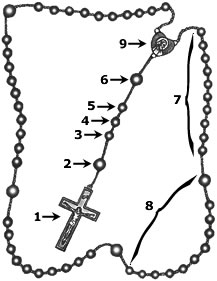
Tomorrow, we begin the Novena of Divine Mercy. The Chaplet of Divine Mercy is recited using ordinary Rosary beads of five decades. The Chaplet is preceded by two opening prayers from the Diary of Saint Maria Faustina Kowalska and followed by a closing prayer.


1. Make the Sign of the Cross

In the name of the Father, and of the Son, and of the Holy Spirit. Amen.

2. Optional Opening Prayers

St. Faustina’s Prayer for Sinners
O Jesus, eternal Truth, our Life, I call upon You and I beg Your mercy for poor sinners. O sweetest Heart of my Lord, full of pity and unfathomable mercy, I plead with You for poor sinners. O Most Sacred Heart, Fount of Mercy from which gush forth rays of inconceivable graces upon the entire human race, I beg of You light for poor sinners. O Jesus, be mindful of Your own bitter Passion and do not permit the loss of souls redeemed at so dear a price of Your most precious Blood. O Jesus, when I consider the great price of Your Blood, I rejoice at its immensity, for one drop alone would have been enough for the salvation of all sinners. Although sin is an abyss of wickedness and ingratitude, the price paid for us can never be equalled. Therefore, let every soul trust in the Passion of the Lord, and place its hope in His mercy. God will not deny His mercy to anyone. Heaven and earth may change, but God's mercy will never be exhausted. Oh, what immense joy burns in my heart when I contemplate Your incomprehensible goodness, O Jesus! I desire to bring all sinners to Your feet that they may glorify Your mercy throughout endless ages (Diary of Saint Maria Faustina Kowalska, 72).

You expired, Jesus, but the source of life gushed forth for souls, and the ocean of mercy opened up for the whole world. O Fount of Life, unfathomable Divine Mercy, envelop the whole world and empty Yourself out upon us.

(Repeat three times)
O Blood and Water, which gushed forth from the Heart of Jesus as a fount of mercy for us, I trust in You!

3. Our Father

Our Father, Who art in heaven, hallowed be Thy name; Thy kingdom come; Thy will be done on earth as it is in heaven. Give us this day our daily bread; and forgive us our trespasses as we forgive those who trespass against us; and lead us not into temptation, but deliver us from evil, Amen.

4. Hail Mary

Hail Mary, full of grace. The Lord is with thee. Blessed art thou amongst women, and blessed is the fruit of thy womb, Jesus. Holy Mary, Mother of God, pray for us sinners, now and at the hour of our death, Amen.

5. The Apostles’ Creed

I believe in God, the Father almighty, Creator of heaven and earth, and in Jesus Christ, His only Son, our Lord, who was conceived by the Holy Spirit, born of the Virgin Mary, suffered under Pontius Pilate, was crucified, died and was buried; He descended into hell; on the third day He rose again from the dead; He ascended into heaven, and is seated at the right hand of God the Father almighty; from there He will come to judge the living and the dead. I believe in the Holy Spirit, the holy catholic Church, the communion of saints, the forgiveness of sins, the resurrection of the body, and life everlasting. Amen.

6. The Eternal Father

Eternal Father, I offer you the Body and Blood, Soul and Divinity of Your Dearly Beloved Son, Our Lord, Jesus Christ, in atonement for our sins and those of the whole world.

7. On the 10 Small Beads of Each Decade

For the sake of His sorrowful Passion, have mercy on us and on the whole world.

8. Repeat for the remaining decades

Saying the "Eternal Father" (6) on the "Our Father" bead and then 10 "For the sake of His sorrowful Passion" (7) on the following "Hail Mary" beads.

9. Conclude with Holy God (Repeat three times)

Holy God, Holy Mighty One, Holy Immortal One, have mercy on us and on the whole world.

10. Optional Closing Prayers

Eternal God, in whom mercy is endless and the treasury of compassion — inexhaustible, look kindly upon us and increase Your mercy in us, that in difficult moments we might not despair nor become despondent, but with great confidence submit ourselves to Your holy will, which is Love and Mercy itself.

O Greatly Merciful God, Infinite Goodness, today all mankind calls out from the abyss of its misery to Your mercy — to Your compassion, O God; and it is with its mighty voice of misery that it cries out. Gracious God, do not reject the prayer of this earth's exiles! O Lord, Goodness beyond our understanding, Who are acquainted with our misery through and through, and know that by our own power we cannot ascend to You, we implore You: anticipate us with Your grace and keep on increasing Your mercy in us, that we may faithfully do Your holy will all through our life and at death's hour. Let the omnipotence of Your mercy shield us from the darts of our salvation’s enemies, that we may with confidence, as Your children, await Your [Son’s] final coming — that day known to You alone. And we expect to obtain everything promised us by Jesus in spite of all our wretchedness. For Jesus is our Hope: through His merciful Heart, as through an open gate, we pass through to heaven (Diary, 1570).

Sunday, March 29, 2026

Passion Sunday 2026 Passion - Golgotha


In the Entrance Gospel, we hear that the people cried Hosanna, looking for a messiah. Jesus is indeed the Messiah, but not the one they expected. In the Passion according to St. Matthew, the people cry out for our Lord to be crucified, and that His blood be on them on on their children, and that is what God the Father intends - that the blood of Jesus Christ be on them to save them, and all mankind. #Catholic #homily #Scripture #GospelOfTheDay #mercywithteeth Sign up to have podcasts and blog posts emailed to you: https://ift.tt/VUPIYCG Give feedback at https://forms.gle/gGhujv39g43BUxmK6 Readings are found at https://ift.tt/fUMrXnA True Mercy Has Teeth: A Catholic Journey to Forgiveness and Healing is now available on Amazon and other places as listed at www.mercywithteeth.com
via IFTTT

Passion Sunday 2026 Entrance - Hosanna


In the Entrance Gospel, we hear that the people cried Hosanna, looking for a messiah. Jesus is indeed the Messiah, but not the one they expected. In the Passion according to St. Matthew, the people cry out for our Lord to be crucified, and that His blood be on them on on their children, and that is what God the Father intends - that the blood of Jesus Christ be on them to save them, and all mankind. https://ift.tt/Pe7R8bH #Catholic #homily #Scripture #GospelOfTheDay #mercywithteeth Sign up to have podcasts and blog posts emailed to you: https://ift.tt/VUPIYCG Give feedback at https://forms.gle/gGhujv39g43BUxmK6 Readings are found at https://ift.tt/fUMrXnA True Mercy Has Teeth: A Catholic Journey to Forgiveness and Healing is now available on Amazon and other places as listed at www.mercywithteeth.com
via IFTTT

Sunday, March 22, 2026

5th Sunday Lent 2026 - Unbound


Jesus raises Lazarus from the dead, though he was dead for 4 days. He exits the tomb, still bound, but this shows the irresistible call of our Lord to life. #Catholic #homily #Scripture #GospelOfTheDay #mercywithteeth Sign up to have podcasts and blog posts emailed to you: https://ift.tt/fVrdlns Give feedback at https://forms.gle/gGhujv39g43BUxmK6 Readings are found at https://ift.tt/d7kwjAm True Mercy Has Teeth: A Catholic Journey to Forgiveness and Healing is now available on Amazon and other places as listed at www.mercywithteeth.com
via IFTTT

Thursday, March 19, 2026

Solemnity of St. Joseph

 https://images.openai.com/static-rsc-4/jlCc5AYDpPJEAKrEx3l_Bjtbo7qO6CSkj1lZBIZW3PLRYdsdGUOkfN-XY-RvVB-xPm2vAwsnjQekR3AgpHsI-TrwZIOwSd0rPWbDJWKrkaSJACrTfXG6YMgP5xGDGYNOI8pBxqpKFh75pE7D3gViGNoXCuUKFrW2L5A7I9nYzRvaF7g7Yt7GMGV7KyzWAT1M?purpose=fullsize


Today we celebrate the Solemnity of Saint Joseph—a man who shows us that mercy is not loud, not flashy, and certainly not weak.

It is strong. Quiet. Steady.

In my book True Mercy Has Teeth, I talk about a kind of mercy that doesn’t ignore sin but chooses love anyway—without compromising truth. St. Joseph lived that kind of mercy.

When he discovered that the Blessed Virgin Mary was with child, he had every legal right to expose her. He could have protected his reputation. He could have chosen justice without compassion.

But instead, as the Gospel tells us, he resolved to divorce her quietly.

Before he understood the full truth, he chose mercy.

Not because he denied the seriousness of the situation—but because his heart was already formed in righteousness, a righteousness rooted in compassion.

And when God revealed the truth to him in a dream, Joseph didn’t hesitate. He took Mary into his home. He embraced a mission that would cost him everything—his plans, his reputation, his comfort.

This is mercy with teeth:

    • Mercy that restrains the impulse to expose or humiliate
    • Mercy that protects the vulnerable
    • Mercy that listens for God before acting
    • Mercy that obeys, even when it’s costly

Joseph never says a word in Scripture, but his actions preach loudly.

In a world that often confuses mercy with permissiveness—or weaponizes truth without love—St. Joseph stands as a model of mercy.

He reminds us that real mercy is not about avoiding hard things.

It’s about choosing God’s will in the hard things.

Today, ask God to give us a heart like St. Joseph:

    A heart that is just
    A heart that is merciful
    A heart strong enough to love when it might cost everything.


St. Joseph, just and merciful,
You chose the path of compassion over condemnation
And faith over fear.
By your example, teach us to be just and loving.
Help us to rise when God calls - quietly, obediently, and faithfully.
Ask your foster Son Jesus Christ to shape in us a heart like yours: firm, patient, and full of mercy.
Amen.

St. Joseph, guardian of the Redeemer and terror of demons—pray for us.

True Mercy Has Teeth is available at Amazon or at www.mercywithteeth.com 
#mercywithteeth

Sunday, March 15, 2026

4th Sunday Lent 2026 - Sent


The Lord heals a man who was born blind, giving the man spiritual sight while the Pharisees become more blind. The man is sent as a witness of the glory of God. #Catholic #homily #Scripture #GospelOfTheDay #mercywithteeth Sign up to have podcasts and blog posts emailed to you: https://ift.tt/sDGaN0e Give feedback at https://forms.gle/gGhujv39g43BUxmK6 Readings are found at https://ift.tt/oadgGlJ True Mercy Has Teeth: A Catholic Journey to Forgiveness and Healing is now available on Amazon and other places as listed at www.mercywithteeth.com
via IFTTT

Sunday, March 8, 2026

3rd Sunday Lent 2026 - Shame


In His conversation with the Samaritan woman at the well, He meets her in her place of shame, and draws out of her faith. Where does He want to meet us? #Catholic #homily #Scripture #GospelOfTheDay #mercywithteeth Sign up to have podcasts and blog posts emailed to you: https://ift.tt/c59UzKM Give feedback at https://forms.gle/gGhujv39g43BUxmK6 Readings are found at https://ift.tt/6Yju7lm True Mercy Has Teeth: A Catholic Journey to Forgiveness and Healing is now available on Amazon and other places as listed at www.mercywithteeth.com
via IFTTT

Tuesday, March 3, 2026

St. Katharine Drexel: Mercy That Refused to Delegate


It is sometimes easier to write a check than to give your life.

For many of us, mercy feels complete once we have donated, signed up, or encouraged someone else to step forward. We mean well. We care. But we often prefer to support mercy rather than embody it.

St. Katharine Drexel shows us a different path.

Born Into Privilege — Called Into Poverty

Katharine Drexel was born in 1858 into one of the wealthiest families in the United States. Her father was a powerful banker, and she grew up surrounded by comfort, refinement, and opportunity. Yet from childhood, she witnessed something else: her parents quietly opened their home to the poor. She learned that wealth was not possession, but stewardship.

After her parents died, Katharine inherited millions. She could have lived a life of philanthropy from a distance, funding schools, sponsoring missionaries, supporting charitable institutions while remaining safely removed from hardship.

And at first, she did just that.

She used her wealth to assist missions to Native American communities and to African Americans who were suffering under the brutal injustices of post–Civil War America. But the more she learned, the more restless she became.

Money was helping.
But it wasn’t enough.

“Why Don’t You Become a Missionary?”

During an audience in Rome, Katharine pleaded with Pope Leo XIII to send more missionaries to serve Native Americans. His response startled her.

He asked, “Why don’t you become a missionary?”

That question pierced her heart.

Mercy, for Katharine, could no longer be something she outsourced.

She realized she had been asking someone else to carry a cross that Christ might be asking her to bear.

Mercy With Skin in the Game

Katharine founded the Sisters of the Blessed Sacrament and dedicated her life to serving African American and Native American communities, communities marginalized, oppressed, and largely abandoned by broader society.

She did not merely fund schools. She built them.

She did not simply advocate for dignity. She lived among those denied it.

She established over 60 schools and institutions, including what would become Xavier University of Louisiana, the only historically Black Catholic university in the United States.

This was not fashionable work. It was controversial. She faced racism, threats, and fierce opposition. Some resented her efforts to educate Black and Native children. Others thought such work was imprudent, even dangerous.

But mercy with teeth is never timid.

The Temptation to Delegate

There is a subtle temptation in all of us.

We see a need and say:

  • “Someone should do something.”

  • “The Church should address this.”

  • “We should pray for more vocations.”

Katharine Drexel heard those same inner whispers and refused them.

Mercy, for her, meant asking not Who will go? but Lord, is it me?

This is often uncomfortable. It disrupts our plans. It risks reputation and security. It sometimes requires proximity to suffering.

But mercy without proximity can become abstraction.

A Question for Us

Most of us are not heirs or heiresses of immense fortunes. We are not being asked to found a religious congregation.

But we are being asked something.

Where are we tempted to ask others to serve rather than become servants?
To recommend rather than respond?
To encourage rather than engage?

Katharine’s life reminds us that mercy is not complete when the check clears. It is complete when love becomes incarnate.

Christ did not delegate the Cross.

And sometimes, neither can we.

Reflection on "Call No Man Father"

In today’s Gospel, Jesus says:

“Call no one on earth your father; you have but one Father in heaven.” (Matthew 23:9)

At first glance, that sounds absolute. Catholics are often questioned, and even condemned, over it. But Catholics understand this passage in light of the whole of Scripture—and especially in context.

1. Jesus Is Condemning Pride, Not Titles

In Gospel of Matthew 23, Jesus is rebuking the scribes and Pharisees for loving honor, status, and public recognition. The issue isn’t vocabulary—it’s spiritual pride and self-exaltation.

If Jesus meant this as a literal prohibition of the word “father,” then we would also have to stop calling:

  • Our biological fathers “father”

  • Abraham “our father in faith” (cf. Romans 4)

  • Any teacher “teacher,” since the same passage also says, “You have but one teacher”

Yet Scripture itself continues to use these terms.

2. St. Paul Calls Himself a Father

In First Letter to the Corinthians 4:14–15, St. Paul writes:

“I am not writing this to shame you, but to admonish you as my beloved children. Even if you should have countless guides to Christ, yet you do not have many fathers, for I became your father in Christ Jesus through the gospel.”

Paul explicitly calls himself their father in Christ.

He does it again in:

  • First Letter to the Thessalonians 2:11 – “We treated each one of you as a father treats his children.”

  • Letter to Philemon 1:10 – He refers to Onesimus as “my child, whose father I have become in my imprisonment.”

If calling a spiritual leader “father” were inherently sinful, Paul would not describe himself this way under the inspiration of the Holy Spirit.

3. The Meaning of “Father” in Catholic Practice

When Catholics call a priest “Father,” we don’t mean:

  • He replaces God the Father

  • He is the ultimate source of life

  • He is superior to others

We mean that he exercises spiritual fatherhood—bringing people to new life in Christ through:

  • Preaching the Gospel

  • Baptism

  • The Sacraments

  • Spiritual guidance

Just as Paul said he became a father “through the gospel.”

4. The Biblical Pattern of Spiritual Fatherhood

Scripture frequently uses fatherly language for spiritual relationships:

  • Abraham is called “our father in faith”

  • Elders in Israel were called fathers

  • Paul uses fatherly imagery for ministry

The fuller context implies that titles, like phylacteries and tassels, mean nothing with out the humble service that ought to be present. Our Lord condemns usurping God’s authority but not acknowledging spiritual fatherhood as participation in God’s fatherhood.

Sunday, March 1, 2026

2nd Sunday Lent 2026 - Prepared


As we continue in Lent, we hear of our Lord’s Transfiguration, an event that gave the Apostles Peter, James, and John a glimpse of our Lord’s Resurrected glory, a foreshadow that the darkness of the Cross would be conquered by His light. #Catholic #homily #Scripture #GospelOfTheDay #mercywithteeth Sign up to have podcasts and blog posts emailed to you: https://ift.tt/14Jq5cK Give feedback at https://forms.gle/gGhujv39g43BUxmK6 Readings are found at https://ift.tt/Rhe0fcw True Mercy Has Teeth: A Catholic Journey to Forgiveness and Healing is now available on Amazon and other places as listed at www.mercywithteeth.com
via IFTTT

Sunday, February 22, 2026

1st Sunday Lent 2026 - Resistance


As He prepared to begin His public ministry, Jesus Christ was tempted by Satan, and He models to us how we should resist Satan. #Catholic #homily #Scripture #GospelOfTheDay #mercywithteeth Sign up to have podcasts and blog posts emailed to you: https://ift.tt/FV8sY4u Give feedback at https://forms.gle/gGhujv39g43BUxmK6 Readings are found at https://ift.tt/CL1FIGi True Mercy Has Teeth: A Catholic Journey to Forgiveness and Healing is now available on Amazon and other places as listed at www.mercywithteeth.com
via IFTTT

Saturday, February 21, 2026

Mercy and St. Peter Damian


Today, on the memorial of Peter Damian, the Church honors a saint who proves that authentic mercy is never sentimental. It is fierce, clear-eyed, and willing to wound in order to heal.

If ever there were a patron for what I call mercy with teeth, it is this 11th-century reformer.

A Church in Crisis

Peter Damian did not live in calm ecclesial times. The 1000s ad were marked by serious moral corruption among clergy: simony (the buying and selling of Church offices), concubinage, and sexual immorality. In some places, religious vows and priestly promises were treated as flexible suggestions rather than sacred promises.

Rather than look away, Peter wrote directly to the pope in a treatise known as the Liber Gomorrhianus (Book of Gomorrah). In it, he addressed sexual sins among clergy with disarming clarity. He did not minimize the evil. He did not excuse it as weakness. He did not hide behind vague language.

He named it.

And he demanded accountability.

Strong Medicine for Sick Souls

Peter Damian recommended firm, even severe, penalties for clerics who violated their vows and promises—especially those who exploited others. He called for removal from ministry in grave cases. He urged real penance, not cosmetic apologies. He insisted that shepherds who wounded the flock should not simply resume leadership as if nothing had happened.

Why so strong?

Because he understood something we often forget: mercy without justice is not mercy. It is indifference dressed up as compassion.

A priest’s vows and promises are not private lifestyle choices. They are public, sacred promises made before God for the sake of souls. When they are violated—particularly in ways that harm the vulnerable—the wound is not merely personal. It is ecclesial. It is spiritual. It is scandal in the deepest biblical sense.

Peter Damian believed that tolerating grave sin in clergy was itself a failure of charity.

Mercy That Refuses to Lie

Modern ears can find Peter Damian’s tone harsh. But beneath his severity was a profound pastoral concern:

  • Sin destroys the sinner.
  • Sin harms the innocent.
  • Sin disfigures the Church.
  • And pretending otherwise compounds the damage.

True mercy does not pretend evil is smaller than it is.

True mercy does not prioritize institutional comfort over wounded souls.

True mercy calls the sinner to repentance—even if that repentance includes humiliation, removal, or lifelong penance.

That is not cruelty. That is love that refuses to lie.

The Courage to Purify

It is tempting in every age to avoid conflict “for the good of the Church.” But Peter Damian teaches the opposite: the Church is strengthened, not weakened, by purification.

Holiness requires clarity.

Reform requires courage.

And charity sometimes requires consequences.

In my own work writing about forgiveness and healing, I have often said that authentic mercy has teeth. It does not excuse. It does not enable. It does not call darkness light. It seeks the salvation of the sinner and the protection of the vulnerable at the same time.

Peter Damian understood that protecting the flock is mercy.

Holding shepherds accountable is mercy.

Calling sin by its name is mercy.

A Saint for Our Time

The memorial of St. Peter Damian is not merely historical remembrance. It is a summons.

  • For bishops: to shepherd with courage.
  • For priests: to live vows and promises with integrity.
  • For laity: to demand holiness without hatred.
  • For all of us: to accept correction as grace.

The saint who confronted corruption in the 11th century still speaks today.

May we have his clarity.

May we have his courage.

And may we learn that mercy is strongest when it is rooted in truth.

St. Peter Damian, pray for the Church—and teach us how to love her enough to purify her.

Wednesday, February 18, 2026

Ash Wednesday 2026 - Receive


As we begin Lent, we call to mind that the righteous deeds we do may be done for wrong reasons, and we will receive what we are looking for. Let us seek the Lord. #Catholic #homily #Scripture #GospelOfTheDay #mercywithteeth Sign up to have podcasts and blog posts emailed to you: https://ift.tt/zerBy8v Give feedback at https://forms.gle/gGhujv39g43BUxmK6 Readings are found at https://ift.tt/OFxR0s3 True Mercy Has Teeth: A Catholic Journey to Forgiveness and Healing is now available on Amazon and other places as listed at www.mercywithteeth.com
via IFTTT

Sunday, February 15, 2026

6th Sunday Ordinary 2026 - Raised


Jesus teaches that our behavior must be higher than the scribes and pharisees, and that following the commandments is more than the letter of the Law, but raised. With His grace, we can avoid sin. #Catholic #homily #Scripture #GospelOfTheDay #mercywithteeth Sign up to have podcasts and blog posts emailed to you: https://ift.tt/IEi6FUm Give feedback at https://forms.gle/gGhujv39g43BUxmK6 Readings are found at https://ift.tt/Q28TiEs True Mercy Has Teeth: A Catholic Journey to Forgiveness and Healing is now available on Amazon and other places as listed at www.mercywithteeth.com
via IFTTT

Sunday, February 8, 2026

5th Sunday Ordinary Time 2026 - Essential


Our Lord Jesus continues with His Sermon on the Mount, telling His disciples they are salt and light. These are not insignificant things, but rather essential for life. #Catholic #homily #Scripture #GospelOfTheDay #mercywithteeth Sign up to have podcasts and blog posts emailed to you: https://ift.tt/WbEoTzS Give feedback at https://forms.gle/gGhujv39g43BUxmK6 Readings are found at https://ift.tt/lvejs7p True Mercy Has Teeth: A Catholic Journey to Forgiveness and Healing is now available on Amazon and other places as listed at www.mercywithteeth.com
via IFTTT

Friday, February 6, 2026

Reflection on the Japanese Martyrs

Today is the feast of St. Paul Miki and Companions — 26 men of varying ages: Franciscan and Jesuit priests, catechists, and laymen. They were crucified in 1597 for the crime of being Catholic in a Japan that, at the time, was violently opposed to outside influence — especially the Catholic faith.


The foreign missionaries left behind knew it was only a matter of time before they, too, would be discovered. Anyone wise in the ways of the world would have sought escape, saved their own life, or denied the faith.


They did not.


Before the missionaries were martyred or expelled, they did something extraordinary: they prepared the faithful for a Church without clergy. They told them, one day men will come claiming to be ministers — here is how you will know the true Church.


They gave them three signs to watch for:

    • A priest who was not married

    • Devotion to the Blessed Virgin Mary

    • Union with the Pope in Rome


Generations passed. Children were baptized by grandparents. Prayers were whispered — distorted, half-forgotten — yet guarded like treasure.


For more than 250 years, Japan had no Catholic priests.


When Japan reopened in the 1800s, villagers quietly approached a French priest and asked:

    “Are you married?”

    “Do you honor Santa Maria?”

    “Are you united to the Pope of Rome?”


When he answered correctly, they said:

    “Our hearts are the same as yours.”


After centuries in hiding, the faith endured — not sentimental, not soft, but rooted, costly, and recognizable.


That story has been on my heart today as an example of mercy.

Because real mercy isn’t vague.

It puts others first, seeking their good.

It isn’t whatever survives cultural pressure.

It has edges, marks, and a memory.


True mercy clings to truth — even when truth must be whispered in the dark.

Sunday, February 1, 2026

4th Sunday Ordinary Time 2026 - Meek


Jesus Christ begins His Sermon on the Mount with a radical invitation to see the world in a new way - this is the meaning of metanoia. He especially invites us to meekness, a quality that these times so desperately need. #Catholic #homily #Scripture #GospelOfTheDay #mercywithteeth Sign up to have podcasts and blog posts emailed to you: https://ift.tt/htIOWnB Give feedback at https://forms.gle/gGhujv39g43BUxmK6 Readings are found at https://ift.tt/Hc1JQFm True Mercy Has Teeth: A Catholic Journey to Forgiveness and Healing is now available on Amazon and other places as listed at www.mercywithteeth.com
via IFTTT

Thursday, January 29, 2026

Seeking Truth and Mercy in a Time of Division

In recent days, the deaths of two people by federal agents has stirred powerful emotions across our nation. Different narratives have emerged about what happened, and people on both sides are sharing facts that support their own understanding of the event. Some say one thing; others say something quite different. And the more the story unfolds, the more important it becomes for us, as disciples of Christ, to pause and ask: Are we seeing all the facts, or only the ones that confirm what we already think?

If I can use a simple analogy: I can say “A masked man cut me.” That could describe a terrifying mugging by a masked assailant, or a masked surgeon using a scalpel in the operating room. Both understandings are literally true—but the context and more nuanced words helping to clarify facts changes everything. Without seeing the whole scene, without examining all the facts, we risk misunderstanding the reality and turning compassion into judgment, or righteous anger into false accusation. 

Even with a little more context, we need to be careful before drawing conclusions. Out there, there might be a manic medic, causing grave bodily harm with a primary instrument of his or her trade. There is rarely black and white - context and the fullness of the facts matter. Otherwise good people can do terrible things. And sharing only the facts that demonize or canonize someone is disingenuous and wrong, no matter which side or whatever motive.

In True Mercy Has Teeth, I write about holy confrontation—the courage to name what is true, and to seek the full truth, not a partial story that fits our preconceptions. A holy confrontation is one in which the facts are presented in their fullness. Only by doing so can the truth is discerned, and lead to the pathos proper accountability, hopeful healing, and lasting reconciliation.

One of the key paragraphs in that chapter: "Confrontation is most effective when both sides can discuss the matter calmly and without overly emotional language or blaming. Both need to desire to understand all sides of the truth, not just arguing from emotion. It also requires both to desire to find the truth, not just be right." I would now add that both need to recognize the other as created in the image and likeness of God, be willing to accept the humanity of the other, and be ready to change one's mind and to apologize and forgive.

As people of faith, we are called not only to condemn evil wherever and whenever it occurs, but also to seek the full picture before locking in our conclusions. This is not moral neutrality—it is obedience to truth. It is possible, and even necessary, to hold compassion for the victims, a desire for justice, and a commitment to truth, all at once. This deep discernment reflects the heart of Christ, who weeps with us, stands with us in pain, and calls us to look beyond our initial reactions. This is mercy with teeth.

Let us pray that the investigations reveal the truth in full, that those who have died be granted mercy, the guilty are held accountable, and that our responses as a community be led by truth and compassion—not just the fragments that confirm our fears or our ideologies.

May the Lord grant us peace and the humility to seek truth at all times. May the Lord grant us peace and the humility to seek truth at all times.

Wednesday, January 28, 2026

“The Dumb Ox” Who Shook the World

As a young student, St. Thomas Aquinas was mocked by his classmates and called “the dumb ox.”

He was big. He was quiet. He didn’t argue for attention or rush to prove himself.
They mistook silence for stupidity.
But his teacher, St. Albert the Great, saw what others missed and famously replied:
“You call him a dumb ox, but his bellowing will one day be heard throughout the world.”
And it was.
Thomas Aquinas would become one of the greatest minds the Church has ever known—not because he demanded recognition, but because he practiced humility, patience, and obedience to truth.
This story has stayed with me, and it echoes something I explore deeply in True Mercy Has Teeth:
Mercy is not weakness.
Silence is not surrender.
Meekness is not the absence of strength—it is strength rightly ordered.
Sometimes God is doing His deepest work in us while the world is busy mislabeling us.
If you’ve ever felt underestimated, misunderstood, or dismissed for being “too quiet,” take heart. God may be forming something far greater than appearances suggest.
True Mercy Has Teeth: A Catholic Journey to Forgiveness and Healing
Available now.