Showing posts with label Catholic. Show all posts
Showing posts with label Catholic. Show all posts
Sunday, July 12, 2026
15th Sunday 2026 - Parables
Jesus told parables to show a deeper reality, as a call to conversion. He told them that those with humble enough hearts could understand, while the wise and the learned would remain confused. #Catholic #homily #Scripture #GospelOfTheDay #mercywithteeth Sign up to have podcasts and blog posts emailed to you: https://ift.tt/f9uBMUZ Give feedback at https://forms.gle/gGhujv39g43BUxmK6 Readings are found at https://ift.tt/jM8YNRv True Mercy Has Teeth: A Catholic Journey to Forgiveness and Healing is now available on Amazon and other places as listed at www.mercywithteeth.com
via IFTTT

Sunday, July 5, 2026
14th Sunday 2026 - Rest
Our Lord Jesus invites us to come to Him, where we will find rest. It is Him alone that we can. #Catholic #homily #Scripture #GospelOfTheDay #mercywithteeth Sign up to have podcasts and blog posts emailed to you: https://ift.tt/oqgtxM8 Give feedback at https://forms.gle/gGhujv39g43BUxmK6 Readings are found at https://ift.tt/XG0sT9F True Mercy Has Teeth: A Catholic Journey to Forgiveness and Healing is now available on Amazon and other places as listed at www.mercywithteeth.com
via IFTTT
Sunday, June 28, 2026
13th Sunday 2026 - Priority
Our Lord invites us to follow Him and make Him our priority. Unlike finite resources, though, when we give Him our love first, He give us what we need to love others. #Catholic #homily #Scripture #GospelOfTheDay #mercywithteeth Sign up to have podcasts and blog posts emailed to you: https://ift.tt/pklxz7D Give feedback at https://forms.gle/gGhujv39g43BUxmK6 Readings are found at https://ift.tt/IuSVyxr True Mercy Has Teeth: A Catholic Journey to Forgiveness and Healing is now available on Amazon and other places as listed at www.mercywithteeth.com
via IFTTT
Sunday, May 17, 2026
Ascension 2026 - Friend
Jesus Ascends to heaven, entrusting the mission of making disciples to His disciples, which includes us. Maybe, if we see this task first as introducing others to Jesus Christ our Savior as a friend, the mission is not too difficult. #Catholic #homily #Scripture #GospelOfTheDay #mercywithteeth Sign up to have podcasts and blog posts emailed to you: https://ift.tt/6miOYEj Give feedback at https://forms.gle/gGhujv39g43BUxmK6 Readings are found at https://ift.tt/kgCcNb6 True Mercy Has Teeth: A Catholic Journey to Forgiveness and Healing is now available on Amazon and other places as listed at www.mercywithteeth.com
via IFTTT
Wednesday, April 29, 2026
St. Catherine of Sienna - Fire of Mercy

The life of St. Catherine of Siena confronts us with a truth we often resist: real mercy is not timid. It does not whisper when souls are at stake. It speaks—with clarity, urgency, and love that is willing to risk everything.
St. Catherine of Siena shows us mercy with fire—love for Christ and His Church that refused to stay silent in a moment of crisis.
A Church Out of Place
In the 14th century, the papacy was not in Rome. For decades, the popes resided in Avignon, in what is now southern France—a period we now call the Avignon Papacy. What began as a political relocation had become a spiritual and symbolic wound.
Rome stood empty.
The Church’s unity was strained. Its credibility weakened. Its shepherd seemed distant from his flock.
Many recognized the problem. Few were willing to confront it.
St. Catherine was.
A Laywoman Who Spoke Like a Prophet
St. Catherine was of course not a bishop or priest. Nor was she a theologian in the academic sense. She was not a person of institutional authority.
She was a Dominican tertiary. A laywoman. A mystic.
And yet, she wrote boldly to Pope Gregory XI, urging him to return to Rome. Her letters are astonishing—not because they are rebellious, but because they are rooted in profound obedience and love for the Church.
She called him “sweet Christ on earth.”
And then she told him the truth.
She warned against cowardice. She urged him to act with courage. She reminded him of his responsibility before God. She did not flatter him into comfort—she loved him into conversion.
This is the heart of mercy with teeth.
Mercy That Calls to Courage
In True Mercy Has Teeth, I argue that mercy is not the absence of challenge—it is the presence of truth spoken for the sake of salvation.
St. Catherine embodies this.
Her concern was not political strategy. It was the salvation of souls and the integrity of the Church. She saw that hesitation at the highest levels had consequences for everyone.
So she spoke.
Not with bitterness. Not with contempt. But with a kind of holy urgency that refused to let fear have the final word.
And remarkably—he listened.
In 1377, Pope Gregory XI returned the papacy to Rome. St. Catherine’s influence was not the only factor, but it was significant. Her courage helped move history.
The Cost of Loving the Church
St. Catherine’s story did not end in triumphal peace. The years that followed were marked by even greater turmoil, including the Western Schism. She suffered. She labored. She poured herself out for a Church that was, at times, deeply wounded.
But she never withdrew her love.
This is another mark of real mercy: it does not abandon when things get messy.
It stays.
It speaks.
It suffers.
And it hopes.
A Saint for a Wounded Age
It is easy to romanticize saints like St. Catherine—until we realize what her witness demands of us.
- To love the Church enough to speak truth, even upward
- To call leaders to holiness without rejecting their authority
- To refuse both silence and cynicism
- To act, not from outrage, but from charity
St. Catherine shows us that reform in the Church has always come from saints who were willing to risk misunderstanding for the sake of fidelity.
She did not seek power.
She sought holiness—and trusted that truth, spoken in love, could move even the heart of a pope.
Mercy That Burns
St. Catherine of Siena shows us the fire of mercy.
Mercy that burns away cowardice.
Mercy that refuses to let fear dictate decisions.
Mercy that calls the Church back to where she belongs.
Today, her voice still echoes:
“Be who God meant you to be, and you will set the world on fire.”
May we have the courage to live a mercy like that—not comfortable, not passive, but alive with truth and love.
St. Catherine of Siena, pray for us—and teach us how to love the Church enough to call her higher.
Sunday, April 12, 2026
St. Faustina's Prayer to Be Merciful
O Most Holy Trinity! As many times as I breathe, as many times as my heart beats, as many times as my blood pulsates through my body, so many thousand times do I want to glorify your mercy. I want to be completely transformed into your mercy and to be Your living reflection O Lord. May the greatest of all divine attributes, that of your unfathomable mercy pass through my heart and soul to my neighbor. Help me O Lord that my eyes may be merciful, so that I may never suspect or judge from appearances, but look for what is beautiful in my neighbors souls and come to their rescue. Help me O Lord that my ears may be merciful, so that I may give heed to my neighbors needs and not be indifferent to their pains and moanings. Help me O Lord that my tongue may be merciful so that I should never speak negatively of my neighbor, but have a word of comfort and forgiveness for all. Help me O Lord that my hands may be merciful and filled with good deeds, so that I may do only good to my neighbors and take upon my self the more difficult and toilsome tasks. Help me O Lord that my feet may be merciful, so that I may hurry to assist my neighbor, overcoming my own fatigue and weariness. My true rest is in the service of my neighbor. Help me O Lord that my heart may be merciful so that I myself may feel all the sufferings of my neighbor. I will refuse my heart to no one. I will be sincere even with those who will abuse my kindness. And I will lock myself up in the most merciful Heart of Jesus. I will bear my own suffering in silence. May your mercy O Lord rest upon me. You yourself command me to exercise the three degrees of mercy. The first; the act of mercy of whatever kind. The second; the word of mercy – if I cannot carry out a work of mercy, I will assist by my words. The third; prayer – if I cannot show mercy by deeds or words, I can always do so by prayer. My prayer reaches out even there where I cannot reach out physically. O my Jesus, transform me into yourself, for you can do all things.
Saturday, April 11, 2026
Ninth Day of Divine Mercy Novena
Ninth Day:
Today bring to Me SOULS WHO HAVE BECOME LUKEWARM,* and immerse them in the abyss of My mercy. These souls wound My Heart most painfully. My soul suffered the most dreadful loathing in the Garden of Olives because of lukewarm souls. They were the reason I cried out: 'Father, take this cup away from Me, if it be Your will.' For them, the last hope of salvation is to run to My mercy.
Most compassionate Jesus, You are Compassion Itself. I bring lukewarm souls into the abode of Your Most Compassionate Heart. In this fire of Your pure love, let these tepid souls, who, like corpses, filled You with such deep loathing, be once again set aflame. O Most Compassionate Jesus, exercise the omnipotence of Your mercy and draw them into the very ardor of Your love, and bestow upon them the gift of holy love, for nothing is beyond Your power.
Eternal Father, turn Your merciful gaze upon lukewarm souls who are nonetheless enfolded in the Most Compassionate Heart of Jesus. Father of Mercy, I beg You by the bitter Passion of Your Son and by His three-hour agony on the Cross: Let them, too, glorify the abyss of Your mercy. Amen.
Friday, April 10, 2026
Eighth Day of Divine Mercy Novena
Eighth Day:
Today bring to Me THE SOULS WHO ARE DETAINED IN PURGATORY, and immerse them in the abyss of My mercy. Let the torrents of My Blood cool down their scorching flames. All these souls are greatly loved by Me. They are making retribution to My justice. It is in your power to bring them relief. Draw all the indulgences from the treasury of My Church and offer them on their behalf. Oh, if you only knew the torments they suffer, you would continually offer for them the alms of the spirit and pay off their debt to My justice.
Most Merciful Jesus, You Yourself have said that You desire mercy; so I bring into the abode of Your Most Compassionate Heart the souls in Purgatory, souls who are very dear to You, and yet, who must make retribution to Your justice. May the streams of Blood and Water which gushed forth from Your Heart put out the flames of Purgatory, that there, too, the power of Your mercy may be celebrated.
Eternal Father, turn Your merciful gaze upon the souls suffering in Purgatory, who are enfolded in the Most Compassionate Heart of Jesus. I beg You, by the sorrowful Passion of Jesus Your Son, and by all the bitterness with which His most sacred Soul was flooded: Manifest Your mercy to the souls who are under Your just scrutiny. Look upon them in no other way but only through the Wounds of Jesus, Your dearly beloved Son; for we firmly believe that there is no limit to Your goodness and compassion. Amen.
Thursday, April 9, 2026
Seventh Day of Divine Mercy Novena
Seventh Day:
Today bring to Me THE SOULS WHO ESPECIALLY VENERATE AND GLORIFY MY MERCY,* and immerse them in My mercy. These souls sorrowed most over my Passion and entered most deeply into My spirit. They are living images of My Compassionate Heart. These souls will shine with a special brightness in the next life. Not one of them will go into the fire of hell. I shall particularly defend each one of them at the hour of death.
Most Merciful Jesus, whose Heart is Love Itself, receive into the abode of Your Most Compassionate Heart the souls of those who particularly extol and venerate the greatness of Your mercy. These souls are mighty with the very power of God Himself. In the midst of all afflictions and adversities they go forward, confident of Your mercy; and united to You, O Jesus, they carry all mankind on their shoulders. These souls will not be judged severely, but Your mercy will embrace them as they depart from this life.
Eternal Father, turn Your merciful gaze upon the souls who glorify and venerate Your greatest attribute, that of Your fathomless mercy, and who are enclosed in the Most Compassionate Heart of Jesus. These souls are a living Gospel; their hands are full of deeds of mercy, and their hearts, overflowing with joy, sing a canticle of mercy to You, O Most High! I beg You O God:
Show them Your mercy according to the hope and trust they have placed in You. Let there be accomplished in them the promise of Jesus, who said to them that during their life, but especially at the hour of death, the souls who will venerate this fathomless mercy of His, He, Himself, will defend as His glory. Amen.
Tuesday, April 7, 2026
Fifth Day of Divine Mercy Novena
Fifth Day:
Today bring to Me THE SOULS OF THOSE WHO HAVE SEPARATED THEMSELVES FROM MY CHURCH,* and immerse them in the ocean of My mercy. During My bitter Passion they tore at My Body and Heart, that is, My Church. As they return to unity with the Church, My wounds heal and in this way they alleviate My Passion.
Most Merciful Jesus, Goodness Itself, You do not refuse light to those who seek it of You. Receive into the abode of Your Most Compassionate Heart the souls of those who have separated themselves from Your Church. Draw them by Your light into the unity of the Church, and do not let them escape from the abode of Your Most Compassionate Heart; but bring it about that they, too, come to glorify the generosity of Your mercy.
Eternal Father, turn Your merciful gaze upon the souls of those who have separated themselves from Your Son's Church, who have squandered Your blessings and misused Your graces by obstinately persisting in their errors. Do not look upon their errors, but upon the love of Your own Son and upon His bitter Passion, which He underwent for their sake, since they, too, are enclosed in His Most Compassionate Heart. Bring it about that they also may glorify Your great mercy for endless ages. Amen.
Monday, April 6, 2026
Fourth Day of Divine Mercy Novena
Fourth Day:
Today bring to Me The PAGANS AND THOSE WHO DO NOT YET KNOW ME. I was thinking also of them during My bitter Passion, and their future zeal comforted My Heart. Immerse them in the ocean of My mercy.
Most compassionate Jesus, You are the Light of the whole world. Receive into the abode of Your Most Compassionate Heart the souls of those who do not believe in God and of those who as yet do not know You. Let the rays of Your grace enlighten them that they, too, together with us, may extol Your wonderful mercy; and do not let them escape from the abode which is Your Most Compassionate Heart.
Eternal Father, turn Your merciful gaze upon the souls of those who do not believe in You, and of those who as yet do not know You, but who are enclosed in the Most Compassionate Heart of Jesus. Draw them to the light of the Gospel. These souls do not know what great happiness it is to love You. Grant that they, too, may extol the generosity of Your mercy for endless ages. Amen.
Sunday, April 5, 2026
Easter Sequence
Christians, to the Paschal Victim
Offer your thankful praises!
A Lamb the sheep redeems;
Christ, who only is sinless,
Reconciles sinners to the Father.
Death and life have contended
in that combat stupendous:
The Prince of life,
who died, reigns immortal.
Speak, Mary, declaring
What you saw, wayfaring.
"The tomb of Christ, who is living,
The glory of Jesus' resurrection;
bright angels attesting,
The shroud and napkin resting.
Yes, Christ my hope is arisen;
to Galilee he goes before you."
Christ indeed from death is risen,
our new life obtaining.
Have mercy, victor King,
ever reigning! Amen. Alleluia.
Third Day of Divine Mercy Novena
Third Day:
Today bring to Me ALL DEVOUT AND FAITHFUL SOULS, and immerse them in the ocean of My mercy. The souls brought Me consolation on the Way of the Cross. They were that drop of consolation in the midst of an ocean of bitterness.
Most Merciful Jesus, from the treasury of Your mercy, You impart Your graces in great abundance to each and all. Receive us into the abode of Your Most Compassionate Heart and never let us escape from It. We beg this grace of You by that most wonderous love for the heavenly Father with which Your Heart burns so fiercely.
Eternal Father, turn Your merciful gaze upon faithful souls, as upon the inheritance of Your Son. For the sake of His sorrowful Passion, grant them Your blessing and surround them with Your constant protection. Thus may they never fail in love or lose the treasure of the holy faith, but rather, with all the hosts of Angels and Saints, may they glorify Your boundless mercy for endless ages. Amen.
Saturday, April 4, 2026
Exultet
Exult, let them exult, the hosts of heaven,
exult, let Angel ministers of God exult,
let the trumpet of salvation
sound aloud our mighty King's triumph!
Be glad, let earth be glad, as glory floods her,
ablaze with light from her eternal King,
let all corners of the earth be glad,
knowing an end to gloom and darkness.
Rejoice, let Mother Church also rejoice,
arrayed with the lightning of his glory,
let this holy building shake with joy,
filled with the mighty voices of the peoples.
(Therefore, dearest friends,
standing in the awesome glory of this holy light,
invoke with me, I ask you,
the mercy of God almighty,
that he, who has been pleased to number me,
though unworthy, among the Levites,
may pour into me his light unshadowed,
that I may sing this candle's perfect praises.)
(V. The Lord be with you.
R. And with your spirit.)
V. Lift up your hearts.
R. We lift them up to the Lord.
V. Let us give thanks to the Lord our God.
R. It is right and just.
It is truly right and just, with ardent love of mind and heart
and with devoted service of our voice,
to acclaim our God invisible, the almighty Father,
and Jesus Christ, our Lord, his Son, his Only Begotten.
Who for our sake paid Adam's debt to the eternal Father,
and, pouring out his own dear Blood,
wiped clean the record of our ancient sinfulness.
These, then, are the feasts of Passover,
in which is slain the Lamb, the one true Lamb,
whose Blood anoints the doorposts of believers.
This is the night,
when once you led our forebears, Israel's children,
from slavery in Egypt
and made them pass dry-shod through the Red Sea.
This is the night
that with a pillar of fire
banished the darkness of sin.
This is the night
that even now, throughout the world,
sets Christian believers apart from worldly vices
and from the gloom of sin,
leading them to grace
and joining them to his holy ones.
This is the night,
when Christ broke the prison-bars of death
and rose victorious from the underworld.
Our birth would have been no gain,
had we not been redeemed.
O wonder of your humble care for us!
O love, O charity beyond all telling,
to ransom a slave you gave away your Son!
O truly necessary sin of Adam,
destroyed completely by the Death of Christ!
O happy fault
that earned so great, so glorious a Redeemer!
O truly blessed night,
worthy alone to know the time and hour
when Christ rose from the underworld!
This is the night
of which it is written:
The night shall be as bright as day,
dazzling is the night for me,
and full of gladness.
The sanctifying power of this night
dispels wickedness, washes faults away,
restores innocence to the fallen, and joy to mourners,
drives out hatred, fosters concord, and brings down the mighty.
On this, your night of grace, O holy Father,
accept this candle, a solemn offering,
the work of bees and of your servants’ hands,
an evening sacrifice of praise,
this gift from your most holy Church.
But now we know the praises of this pillar,
which glowing fire ignites for God's honor,
a fire into many flames divided,
yet never dimmed by sharing of its light,
for it is fed by melting wax,
drawn out by mother bees
to build a torch so precious.
O truly blessed night,
when things of heaven are wed to those of earth,
and divine to the human.
Therefore, O Lord,
we pray you that this candle,
hallowed to the honor of your name,
may persevere undimmed,
to overcome the darkness of this night.
Receive it as a pleasing fragrance,
and let it mingle with the lights of heaven.
May this flame be found still burning
by the Morning Star:
the one Morning Star who never sets,
Christ your Son,
who, coming back from death's domain,
has shed his peaceful light on humanity,
and lives and reigns for ever and ever.
R. Amen.
Excerpt from the English translation of the Roman Missal© 2010, International Commission on English in the Liturgy Corporation. All rights reserved
Office of Readings for Holy Saturday
From the Office of Readings for Holy Saturday: Something strange is happening—there is a great silence on earth today, a great silence and stillness. The whole earth keeps silence because the King is asleep. The earth trembled and is still because God has fallen asleep in the flesh and he has raised up all who have slept ever since the world began. God has died in the flesh and hell trembles with fear. He has gone to search for our first parent, as for a lost sheep. Greatly desiring to visit those who live in darkness and in the shadow of death, he has gone to free from sorrow the captives Adam and Eve, he who is both God and the son of Eve. The Lord approached them bearing the cross, the weapon that had won him the victory. At the sight of him Adam, the first man he had created, struck his breast in terror and cried out to everyone: ‘My Lord be with you all.’ Christ answered him: ‘And with your spirit.’ He took him by the hand and raised him up, saying: ‘Awake, O sleeper, and rise from the dead, and Christ will give you light.’ I am your God, who for your sake have become your son. Out of love for you and for your descendants I now by my own authority command all who are held in bondage to come forth, all who are in darkness to be enlightened, all who are sleeping to arise. I order you, O sleeper, to awake. I did not create you to be held a prisoner in hell. Rise from the dead, for I am the life of the dead. Rise up, work of my hands, you who were created in my image. Rise, let us leave this place, for you are in me and I am in you; together we form only one person and we cannot be separated. For your sake I, your God, became your son; I, the Lord, took the form of a slave; I, whose home is above the heavens, descended to the earth and beneath the earth. For your sake, for the sake of man, I became like a man without help, free among the dead. For the sake of you, who left a garden, I was betrayed to the Jews in a garden, and I was crucified in a garden. See on my face the spittle I received in order to restore to you the life I once breathed into you. See there the marks of the blows I received in order to refashion your warped nature in my image. On my back see the marks of the scourging I endured to remove the burden of sin that weighs upon your back. See my hands, nailed firmly to a tree, for you who once wickedly stretched out your hand to a tree. I slept on the cross and a sword pierced my side for you who slept in paradise and brought forth Eve from your side. My side has healed the pain in yours. My sleep will rouse you from your sleep in hell. The sword that pierced me has sheathed the sword that was turned against you. Rise, let us leave this place. The enemy led you out of the earthly paradise. I will not restore you to that paradise, but I will enthrone you in heaven. I forbade you the tree that was only a symbol of life, but see, I who am life itself am now one with you. I appointed cherubim to guard you as slaves are guarded, but now I make them worship you as God. The throne formed by cherubim awaits you, its bearers swift and eager. The bridal chamber is adorned, the banquet is ready, the eternal dwelling places are prepared, the treasure houses of all good things lie open. The kingdom of heaven has been prepared for you from all eternity.
Second Day of Divine Mercy Novena
Second Day:
Today bring to Me THE SOULS OF PRIESTS AND RELIGIOUS, and immerse them in My unfathomable mercy. It was they who gave Me strength to endure My bitter Passion. Through them as through channels My mercy flows out upon mankind.
Most Merciful Jesus, from whom comes all that is good, increase Your grace in men and women consecrated to Your service,* that they may perform worthy works of mercy; and that all who see them may glorify the Father of Mercy who is in heaven.
Eternal Father, turn Your merciful gaze upon the company of chosen ones in Your vineyard—upon the souls of priests and religious; and endow them with the strength of Your blessing. For the love of the Heart of Your Son in which they are enfolded, impart to them Your power and light, that they may be able to guide others in the way of salvation and with one voice sing praise to Your boundless mercy for ages without end. Amen.
Friday, April 3, 2026
First Day of Divine Mercy Novena
First Day:
Today bring to Me ALL MANKIND, ESPECIALLY ALL SINNERS, and immerse them in the ocean of My mercy. In this way you will console Me in the bitter grief into which the loss of souls plunges Me.
Most Merciful Jesus, whose very nature it is to have compassion on us and to forgive us, do not look upon our sins but upon our trust which we place in Your infinite goodness. Receive us all into the abode of Your Most Compassionate Heart, and never let us escape from It. We beg this of You by Your love which unites You to the Father and the Holy Spirit.
Eternal Father, turn Your merciful gaze upon all mankind and especially upon poor sinners, all enfolded in the Most Compassionate Heart of Jesus. For the sake of His sorrowful Passion show us Your mercy, that we may praise the omnipotence of Your mercy for ever and ever. Amen.
Thursday, April 2, 2026
How to pray the Chaplet of Divine Mercy
How to Recite the Chaplet
Tomorrow, we begin the Novena of Divine Mercy. The Chaplet of Divine Mercy is recited using ordinary Rosary beads of five decades. The Chaplet is preceded by two opening prayers from the Diary of Saint Maria Faustina Kowalska and followed by a closing prayer.
1. Make the Sign of the Cross
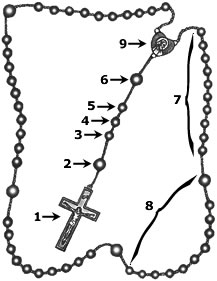
In the name of the Father, and of the Son, and of the Holy Spirit. Amen.
2. Optional Opening Prayers
St. Faustina’s Prayer for Sinners
O Jesus, eternal Truth, our Life, I call upon You and I beg Your mercy for poor sinners. O sweetest Heart of my Lord, full of pity and unfathomable mercy, I plead with You for poor sinners. O Most Sacred Heart, Fount of Mercy from which gush forth rays of inconceivable graces upon the entire human race, I beg of You light for poor sinners. O Jesus, be mindful of Your own bitter Passion and do not permit the loss of souls redeemed at so dear a price of Your most precious Blood. O Jesus, when I consider the great price of Your Blood, I rejoice at its immensity, for one drop alone would have been enough for the salvation of all sinners. Although sin is an abyss of wickedness and ingratitude, the price paid for us can never be equalled. Therefore, let every soul trust in the Passion of the Lord, and place its hope in His mercy. God will not deny His mercy to anyone. Heaven and earth may change, but God's mercy will never be exhausted. Oh, what immense joy burns in my heart when I contemplate Your incomprehensible goodness, O Jesus! I desire to bring all sinners to Your feet that they may glorify Your mercy throughout endless ages (Diary of Saint Maria Faustina Kowalska, 72).
You expired, Jesus, but the source of life gushed forth for souls, and the ocean of mercy opened up for the whole world. O Fount of Life, unfathomable Divine Mercy, envelop the whole world and empty Yourself out upon us.
(Repeat three times)
O Blood and Water, which gushed forth from the Heart of Jesus as a fount of mercy for us, I trust in You!
3. Our Father
Our Father, Who art in heaven, hallowed be Thy name; Thy kingdom come; Thy will be done on earth as it is in heaven. Give us this day our daily bread; and forgive us our trespasses as we forgive those who trespass against us; and lead us not into temptation, but deliver us from evil, Amen.
4. Hail Mary
Hail Mary, full of grace. The Lord is with thee. Blessed art thou amongst women, and blessed is the fruit of thy womb, Jesus. Holy Mary, Mother of God, pray for us sinners, now and at the hour of our death, Amen.
5. The Apostles’ Creed
I believe in God, the Father almighty, Creator of heaven and earth, and in Jesus Christ, His only Son, our Lord, who was conceived by the Holy Spirit, born of the Virgin Mary, suffered under Pontius Pilate, was crucified, died and was buried; He descended into hell; on the third day He rose again from the dead; He ascended into heaven, and is seated at the right hand of God the Father almighty; from there He will come to judge the living and the dead. I believe in the Holy Spirit, the holy catholic Church, the communion of saints, the forgiveness of sins, the resurrection of the body, and life everlasting. Amen.
6. The Eternal Father
Eternal Father, I offer you the Body and Blood, Soul and Divinity of Your Dearly Beloved Son, Our Lord, Jesus Christ, in atonement for our sins and those of the whole world.
7. On the 10 Small Beads of Each Decade
For the sake of His sorrowful Passion, have mercy on us and on the whole world.
8. Repeat for the remaining decades
Saying the "Eternal Father" (6) on the "Our Father" bead and then 10 "For the sake of His sorrowful Passion" (7) on the following "Hail Mary" beads.
9. Conclude with Holy God (Repeat three times)
Holy God, Holy Mighty One, Holy Immortal One, have mercy on us and on the whole world.
10. Optional Closing Prayers
Eternal God, in whom mercy is endless and the treasury of compassion — inexhaustible, look kindly upon us and increase Your mercy in us, that in difficult moments we might not despair nor become despondent, but with great confidence submit ourselves to Your holy will, which is Love and Mercy itself.
O Greatly Merciful God, Infinite Goodness, today all mankind calls out from the abyss of its misery to Your mercy — to Your compassion, O God; and it is with its mighty voice of misery that it cries out. Gracious God, do not reject the prayer of this earth's exiles! O Lord, Goodness beyond our understanding, Who are acquainted with our misery through and through, and know that by our own power we cannot ascend to You, we implore You: anticipate us with Your grace and keep on increasing Your mercy in us, that we may faithfully do Your holy will all through our life and at death's hour. Let the omnipotence of Your mercy shield us from the darts of our salvation’s enemies, that we may with confidence, as Your children, await Your [Son’s] final coming — that day known to You alone. And we expect to obtain everything promised us by Jesus in spite of all our wretchedness. For Jesus is our Hope: through His merciful Heart, as through an open gate, we pass through to heaven (Diary, 1570).
Thursday, March 19, 2026
Solemnity of St. Joseph

It is strong. Quiet. Steady.
In my book True Mercy Has Teeth, I talk about a kind of mercy that doesn’t ignore sin but chooses love anyway—without compromising truth. St. Joseph lived that kind of mercy.
When he discovered that the Blessed Virgin Mary was with child, he had every legal right to expose her. He could have protected his reputation. He could have chosen justice without compassion.
But instead, as the Gospel tells us, he resolved to divorce her quietly.
Before he understood the full truth, he chose mercy.
Not because he denied the seriousness of the situation—but because his heart was already formed in righteousness, a righteousness rooted in compassion.
And when God revealed the truth to him in a dream, Joseph didn’t hesitate. He took Mary into his home. He embraced a mission that would cost him everything—his plans, his reputation, his comfort.
This is mercy with teeth:
• Mercy that restrains the impulse to expose or humiliate
• Mercy that protects the vulnerable
• Mercy that listens for God before acting
• Mercy that obeys, even when it’s costly
Joseph never says a word in Scripture, but his actions preach loudly.
In a world that often confuses mercy with permissiveness—or weaponizes truth without love—St. Joseph stands as a model of mercy.
He reminds us that real mercy is not about avoiding hard things.
It’s about choosing God’s will in the hard things.
Today, ask God to give us a heart like St. Joseph:
A heart that is just
A heart that is merciful
A heart strong enough to love when it might cost everything.
St. Joseph, just and merciful,
You chose the path of compassion over condemnation
And faith over fear.
By your example, teach us to be just and loving.
Help us to rise when God calls - quietly, obediently, and faithfully.
Ask your foster Son Jesus Christ to shape in us a heart like yours: firm, patient, and full of mercy.
Amen.
St. Joseph, guardian of the Redeemer and terror of demons—pray for us.
True Mercy Has Teeth is available at Amazon or at www.mercywithteeth.com
#mercywithteeth
Tuesday, March 3, 2026
St. Katharine Drexel: Mercy That Refused to Delegate
It is sometimes easier to write a check than to give your life.
For many of us, mercy feels complete once we have donated, signed up, or encouraged someone else to step forward. We mean well. We care. But we often prefer to support mercy rather than embody it.
St. Katharine Drexel shows us a different path.
Born Into Privilege — Called Into Poverty
Katharine Drexel was born in 1858 into one of the wealthiest families in the United States. Her father was a powerful banker, and she grew up surrounded by comfort, refinement, and opportunity. Yet from childhood, she witnessed something else: her parents quietly opened their home to the poor. She learned that wealth was not possession, but stewardship.
After her parents died, Katharine inherited millions. She could have lived a life of philanthropy from a distance, funding schools, sponsoring missionaries, supporting charitable institutions while remaining safely removed from hardship.
And at first, she did just that.
She used her wealth to assist missions to Native American communities and to African Americans who were suffering under the brutal injustices of post–Civil War America. But the more she learned, the more restless she became.
Money was helping.
But it wasn’t enough.
“Why Don’t You Become a Missionary?”
During an audience in Rome, Katharine pleaded with Pope Leo XIII to send more missionaries to serve Native Americans. His response startled her.
He asked, “Why don’t you become a missionary?”
That question pierced her heart.
Mercy, for Katharine, could no longer be something she outsourced.
She realized she had been asking someone else to carry a cross that Christ might be asking her to bear.
Mercy With Skin in the Game
Katharine founded the Sisters of the Blessed Sacrament and dedicated her life to serving African American and Native American communities, communities marginalized, oppressed, and largely abandoned by broader society.
She did not merely fund schools. She built them.
She did not simply advocate for dignity. She lived among those denied it.
She established over 60 schools and institutions, including what would become Xavier University of Louisiana, the only historically Black Catholic university in the United States.
This was not fashionable work. It was controversial. She faced racism, threats, and fierce opposition. Some resented her efforts to educate Black and Native children. Others thought such work was imprudent, even dangerous.
But mercy with teeth is never timid.
The Temptation to Delegate
There is a subtle temptation in all of us.
We see a need and say:
“Someone should do something.”
“The Church should address this.”
“We should pray for more vocations.”
Katharine Drexel heard those same inner whispers and refused them.
Mercy, for her, meant asking not Who will go? but Lord, is it me?
This is often uncomfortable. It disrupts our plans. It risks reputation and security. It sometimes requires proximity to suffering.
But mercy without proximity can become abstraction.
A Question for Us
Most of us are not heirs or heiresses of immense fortunes. We are not being asked to found a religious congregation.
But we are being asked something.
Where are we tempted to ask others to serve rather than become servants?
To recommend rather than respond?
To encourage rather than engage?
Katharine’s life reminds us that mercy is not complete when the check clears. It is complete when love becomes incarnate.
Christ did not delegate the Cross.
And sometimes, neither can we.
Subscribe to:
Posts (Atom)