Showing posts with label prayer. Show all posts

Friday, October 16, 2026

St. Margaret Mary Alacoque: The Sacred Heart and Mercy Revealed

What does the Sacred Heart of Jesus reveal to us?

We often picture the familiar image: the heart surrounded by thorns, aflame with love, and wounded, yet still offered to the world. It is an image of tenderness and consolation. Christ loves us personally. He knows our wounds, welcomes the repentant, and pours out mercy upon sinners.

But there is something else in that image.

The thorns are real. The wound is real. The fire is real.

The Sacred Heart reveals a love that is tender enough to forgive us and strong enough to demand our conversion.

That is mercy with teeth.

On October 16, the Church celebrates the memorial of St. Margaret Mary Alacoque, the seventeenth-century Visitation nun whose mystical experiences helped spread devotion to the Sacred Heart of Jesus. Through her witness, the Church was reminded of Christ's burning love for humanity—and of the pain caused when that love is ignored, rejected, or met with indifference.

Her message remains a challenge to anyone who wishes to understand what divine mercy truly means.

A Heart That Loves Without Giving Up

St. Margaret Mary lived in France during the seventeenth century. As a member of the Visitation Order, she sought a life of prayer and fidelity to Christ. During a series of mystical experiences, she understood Jesus to be revealing His Sacred Heart as a sign of his immense love for humanity.

The heart she encountered was not a symbol of distant affection. It was a heart that had loved humanity to the point of suffering.

Christ's love, as Margaret Mary came to understand it, was met with indifference, ingratitude, and rejection—even among those who called themselves his followers.

The image of the Sacred Heart therefore carries a painful question: What do we do with a love so freely given?

We can receive it with gratitude.

We can return it with love.

Or we can take it for granted.

We can receive the sacraments while refusing to change our lives. We can speak about God's mercy while withholding mercy from others. We can claim to love Christ while ignoring the people for whom he gave his life.

The Sacred Heart does not allow us to separate devotion from conversion.

Christ does not reveal His heart simply to make us feel loved. He reveals His heart so that we may learn to love as He loves.

The Wound Beneath the Thorns

The Sacred Heart is wounded because Love makes itself vulnerable.

Jesus did not love humanity from a safe distance. He entered our suffering, accepted the Cross, and gave Himself for sinners. His wounds reveal both the cruelty of sin and the astonishing depth of divine love.

This is where mercy becomes demanding.

If sin were merely a harmless mistake, the Cross would be difficult to explain. But sin damages our relationship with God, wounds our neighbors, and distorts the people we are created to become.

The Cross shows us that sin matters.

It also shows us that sinners matter.

Christ does not respond to human sin by abandoning humanity. He responds by offering Himself for our salvation.

That is the mystery at the heart of mercy: God neither denies the seriousness of evil nor treats the sinner as beyond redemption.

The Sacred Heart holds these truths together.

Mercy does not pretend the wound is harmless. Mercy enters the wound to heal it.

Reparation: Love That Makes a Response

One of the important themes associated with devotion to the Sacred Heart is reparation.

The word can sound unfamiliar, perhaps even uncomfortable. What does it mean to make reparation to the Heart of Jesus?

It does not mean that Christ's sacrifice was insufficient and that we must somehow complete what He failed to accomplish. His saving sacrifice is complete.

Rather, reparation is our loving response to the reality that sin wounds our relationship with God and harms our neighbor. It is a willingness to acknowledge wrongdoing, seek forgiveness, make amends where possible, and offer our love in response to the love we have received.

Consider what happens when we hurt someone we love.

A sincere apology matters, but words alone may not repair the damage. We may need to change our behavior, restore what we took, correct a falsehood, or demonstrate through our actions that we understand the harm we caused.

Love seeks to make things right.

Reparation applies that same logic to our relationship with God. We do not merely say that we are sorry for our sins. We turn away from them. We seek reconciliation through the sacrament of Penance. We offer prayer and acts of charity. We strive to repair the harm our choices have caused.

And we learn to love more faithfully.

Reparation is not an attempt to purchase God's mercy. It is the response of a heart that has finally begun to understand the cost of being loved.

Mercy With Teeth

The Sacred Heart is a powerful image of mercy with teeth because it refuses to reduce love to sentiment.

A sentimental love wants everyone to feel comfortable. It avoids difficult truths and fears that correction might be mistaken for rejection.

Authentic Christian love wants something greater: the true good and salvation of the person.

Sometimes that means offering consolation.

Sometimes it means forgiving an offense.

Sometimes it means confronting a destructive pattern, establishing a necessary boundary, or insisting that wrongdoing be acknowledged.

A parent who loves a child does not encourage the child to keep making choices that will destroy his life. A friend who genuinely cares does not remain silent when a loved one is heading toward disaster. A Church that loves sinners must proclaim both the reality of sin and the greater possibility of redemption.

None of this gives us permission to humiliate people, act cruelly, or confuse our anger with God's justice. Correction must itself be governed by charity, humility, and a desire for the other person's good.

But neither can we call it mercy when we knowingly allow another person to remain trapped in what is destroying him or her.

The Sacred Heart burns with love because Christ desires our salvation.

His mercy is not permission to remain as we are. It is the invitation and the grace to become holy.

The Heart of Christ and the Hearts We Wound

Devotion to the Sacred Heart also asks us to examine our treatment of others.

It is possible to honor the image of Christ's wounded heart while remaining indifferent to the wounded people around us.

We can make time for prayer while refusing to forgive a family member. We can speak passionately about defending the faith while neglecting someone who needs our help. We can condemn the sins of others while making excuses for our own.

The Sacred Heart challenges this division.

If we love Christ, we must learn to recognize the dignity of those He loves. That includes the poor, the forgotten, the wounded, and those whose choices have made them difficult to love.

It also includes people who have harmed us.

To love someone who has done wrong does not mean pretending the wrongdoing never happened. Forgiveness does not automatically restore trust, eliminate consequences, or require us to remain in an unsafe relationship. Justice and protection can be necessary expressions of love.

But we must guard against allowing justified anger to harden into a desire for another person's destruction.

We can seek accountability while praying for conversion.

We can protect the vulnerable while refusing to dehumanize the offender.

We can speak the truth without surrendering charity.

This is not easy. It is precisely why we need the grace of the Sacred Heart.

The heart of Christ is not merely an image to admire. It is the heart we are asking God to form within us.

Come to the Sacred Heart

St. Margaret Mary reminds us that Christ's love is not a vague sentiment or a distant theological idea. It is personal, sacrificial, and offered to each of us.

He knows our sins.

He knows our wounds.

He knows the ways we have been hurt and the ways we have hurt others.

And still, He invites us to come to Him.

But we must come willing to be changed.

We must allow His mercy to expose our excuses, heal our wounds, and challenge our selfishness. We must learn to make reparation where we have caused harm and to extend forgiveness where we have been wounded. We must become people whose love is not merely spoken but demonstrated in truth and action.

The Sacred Heart is aflame because Christ's love has not grown cold.

The thorns remind us that this love has been rejected.

The wound reminds us that this love has suffered.

And the open heart reminds us that, even now, Christ continues to invite us into friendship with Him.

True mercy has teeth. It confronts sin because sin destroys. It calls for reparation because love seeks to make things right. And it offers forgiveness because no repentant sinner is beyond the reach of Christ's heart.

St. Margaret Mary Alacoque, pray for us. May we come to know the love of the Sacred Heart more deeply, respond to that love more faithfully, and become instruments of Christ's merciful and transforming love in the world.

Sacred Heart of Jesus, make our hearts like yours.

Thursday, October 15, 2026

St. Teresa of Ávila: Mercy That Transforms the Soul

Sometimes we imagine that God will draw close to us once we have our lives in order. Once we have overcome that persistent sin, conquered our bad habits, or become the kind of person we think we ought to be, then perhaps we will be ready for a deeper relationship with him.

St. Teresa of Ávila understood how easily we can get this backward.

A Carmelite nun, reformer, mystic, and Doctor of the Church, Teresa knew both the struggle of conversion and the extraordinary patience of God. Her life was not a simple progression from holiness to greater holiness. She experienced years of spiritual inconsistency, distraction in prayer, and the painful recognition that she was not giving God her whole heart.

Yet God did not abandon her.

God's mercy did not excuse Teresa from conversion. It made her conversion possible.

The Mercy That Keeps Calling

Teresa entered the Carmelite monastery of the Incarnation in Ávila as a young woman. Although she had a genuine desire for God, she later described a long period in which she struggled to commit herself fully to prayer. She was drawn to God, yet she also found herself distracted by the comforts and relationships of the world.

Looking back, she recognized how divided her heart had become.

Her experience is familiar to anyone who has ever sincerely desired holiness while repeatedly falling back into old patterns. We can love God and still resist giving him control over certain areas of our lives. We can pray while avoiding the conversion we know prayer demands.

Teresa's story offers hope precisely because she did not pretend these struggles were insignificant.

She came to recognize that God had been patiently pursuing her even when she was slow to respond.

The turning point came as she renewed her commitment to prayer, reflecting especially on an image of the wounded Christ. Confronted with the suffering Christ had endured for her, Teresa became more deeply aware of the love she had received and the response that love deserved.

She did not discover a God who had finally decided to tolerate her.

She discovered more profoundly the God who had never stopped calling her.

Mercy Is More Than Feeling Better

Teresa's experience teaches us something important about mercy.

We sometimes measure mercy by how comforted we feel after receiving it. We want reassurance that God loves us, that our failures are understandable, and that we need not be too troubled by our weaknesses.

There is certainly comfort in God's mercy. But Teresa understood that divine love also exposes the truth about us.

When we encounter the holiness of God, we begin to see our own hearts more clearly. We recognize the ways we have chosen lesser goods over the greatest Good. We see how often pride, fear, vanity, and self-interest have shaped our decisions.

That recognition can be painful.

But it is not the pain of being rejected. It is the pain of discovering how much we have resisted the love we were created to receive.

Mercy tells us the truth about our sin without telling us that our sin is the truth about us.

God sees our failures clearly. He also sees the person he is calling us to become.

His mercy invites us to stop hiding, stop making excuses, and allow his grace to do its work.

Prayer That Changes Us

Teresa became one of the Church's great teachers on prayer. Her writings, particularly The Interior Castle, describe the soul's journey into deeper union with God.

For Teresa, prayer was not simply reciting words or completing a religious obligation. It was growing in friendship with the Lord.

Friendship requires honesty. It also requires time, attention, and a willingness to be changed by the person we love.

We cannot expect a deep friendship with Christ while deliberately keeping him at a distance. Nor can we expect prayer to leave every part of our lives untouched.

As we draw closer to him, we begin to see other people differently. We become more aware of our impatience, our judgments, and our tendency to put ourselves first. We recognize the need to forgive, to make amends, and to change the habits that harm others.

This is where prayer and mercy meet.

The person who receives God's mercy is called to become more merciful. The person who experiences God's patience is challenged to become more patient. The person who discovers that God has not given up on him must learn not to give up too quickly on others.

That does not mean tolerating abuse or abandoning appropriate boundaries. Love sometimes requires correction and firm limits. But we must resist the temptation to confuse another person's struggle with proof that he is beyond redemption.

Teresa's own life reminds us that conversion can take time.

God's patience is not permission to remain unchanged. It is an invitation to keep moving toward him.

Mercy With Teeth

Teresa was not merely a woman of quiet contemplation. She was also a determined reformer who worked to renew Carmelite life.

Her commitment to prayer led her into demanding work. She encountered resistance, misunderstanding, practical difficulties, and opposition. Yet she persevered in the conviction that a deeper life with God was worth pursuing.

Her example challenges the idea that mercy is simply a gentle feeling or a willingness to overlook wrongdoing.

Sometimes mercy requires us to confront what has gone wrong. Sometimes it calls us to reform our habits, correct our course, or undertake difficult work for the good of the Church and the people entrusted to us.

Teresa knew that the journey toward holiness required honesty, discipline, and perseverance.

She also knew that none of these could substitute for God's grace.

This is the balance we need. We cannot save ourselves by our own effort, but neither should we use our weakness as an excuse to stop trying.

Mercy gives us the courage to face what needs to change because we no longer have to face it alone.

God Is Not Finished With You

Perhaps one of the most consoling lessons of Teresa's life is that our spiritual history does not have to determine our spiritual future.

We may regret years spent avoiding prayer. We may grieve the damage caused by our selfishness. We may feel embarrassed by how slowly we have grown or discouraged by sins that seem to return.

Teresa would not tell us that these things do not matter.

She would remind us to bring them honestly before God.

The Lord who calls us to holiness is the same Lord who gives us the grace to pursue it. He does not ask us to manufacture perfection before approaching him. He asks us to turn toward him, trust his love, and cooperate with the work he wishes to accomplish in us.

And as we receive that mercy, we must allow it to extend beyond ourselves.

We are called to be patient with those who are still learning, truthful with those who need correction, protective of those who are vulnerable, and hopeful about the possibility of conversion.

We cannot force another person to change. But we can refuse to make our judgment of that person the final word on what God might accomplish.

Let Nothing Disturb You

Teresa's famous poem, traditionally known by its opening words, Nada te turbe—“Let nothing disturb you”—concludes with the reminder that God alone is sufficient.

These words do not deny the reality of suffering or suggest that Christians should be indifferent to injustice. Teresa knew hardship firsthand.

Rather, they point us toward the foundation of Christian hope. Our circumstances may change. Our emotions may fluctuate. Our efforts may meet resistance. Even our own hearts may disappoint us.

But God's faithfulness does not depend on our perfection.

We can repent because mercy is available. We can persevere because grace is at work. We can love others because we have first been loved by God.

And we can begin again.

St. Teresa of Ávila reminds us that mercy is not merely God's response to our failures. It is the love that draws us into friendship with him and gradually transforms our lives.

May we have the humility to admit where we need conversion, the courage to cooperate with grace, and the patience to allow God to work in us and in others.

True mercy has teeth. It confronts sin, calls us to holiness, and refuses to confuse patience with indifference. But it never forgets that the purpose of correction is transformation and that the purpose of love is union with God.

St. Teresa of Ávila, pray for us, that we may trust God's mercy enough to let him change us.

“Let nothing disturb you, let nothing frighten you. All things are passing; God never changes.”

— St. Teresa of Ávila

Wednesday, October 7, 2026

Our Lady of the Rosary: Mercy that Stands and Fights

We often think of mercy as gentle and passive.

We picture forgiveness, compassion, patience, and kindness. We think of the father running toward his prodigal son, Christ forgiving the repentant sinner, or the Good Samaritan stopping beside the wounded man.

But there is another side to mercy that we sometimes forget.

Sometimes mercy must stand between the powerful and the vulnerable.

Sometimes mercy must resist.

Sometimes mercy must defend.

And sometimes mercy must fight.

The feast of Our Lady of the Rosary, celebrated on October 7, has its roots in one of the most famous battles in Christian history: the Battle of Lepanto in 1571.

It is a story about war, certainly. But it is also a story about prayer, courage, protection, and the responsibility to resist forces that threaten human beings.

It reminds us that mercy is not always passive.

Sometimes mercy has teeth.

The Battle of Lepanto

In 1571, the Ottoman Empire was expanding across the Mediterranean. Christian Europe faced the possibility of further expansion, and the island of Cyprus had recently fallen to the Ottomans.

A coalition known as the Holy League assembled a fleet to confront the Ottoman navy.

On October 7, 1571, the two fleets met in the Gulf of Patras, near Lepanto in modern-day Greece.

The battle was enormous. Hundreds of ships and tens of thousands of men were involved.

The Christian fleet was commanded by Don John of Austria. Among those supporting the Christian cause was Pope St. Pius V.

But Pope Pius did something that went beyond assembling ships and soldiers.

He called Christians to pray the Rosary.

According to tradition, he asked Christians throughout Europe to pray for the success of the fleet. As the battle unfolded, the Rosary became closely associated with the Christian victory.

The Holy League prevailed.

Pope Pius V attributed the victory to the intercession of the Blessed Virgin Mary and established a feast in her honor.

Over time, that commemoration developed into the feast we celebrate today as Our Lady of the Rosary.

The Church does not celebrate war itself.

It celebrates the recognition that there are moments when refusing to resist evil can itself become a failure of charity.

When Peace Requires Resistance

This is an uncomfortable truth.

We rightly praise peace.

Christ calls us to love our enemies.

The Christian cannot turn hatred of another person into a virtue.

But peace is not the same thing as passivity.

Imagine a child being abused.

Imagine a woman being attacked.

Imagine a tyrant imprisoning innocent people.

Imagine someone with power exploiting those who have none.

What does mercy require?

Does mercy simply say, “We should not fight”?

No.

Mercy asks what love requires of us in the presence of another person's suffering.

Sometimes love requires forgiveness.

Sometimes it requires reconciliation.

Sometimes it requires boundaries.

And sometimes it requires standing between the victim and the one causing the harm.

That is not hatred.

That is protection.

Mercy for the Oppressed

The Christian understanding of mercy begins with the recognition that every human being possesses God-given dignity.

That includes the victim.

It also includes the perpetrator.

This is where Christian mercy becomes demanding.

To defend the oppressed does not require us to hate the oppressor.

Indeed, authentic Christian love requires us to desire the conversion of the oppressor as well.

But desiring someone's conversion does not mean allowing them to continue harming others.

Stopping evil can itself be an act of love.

A person who repeatedly abuses another person may need to be stopped.

A criminal may need to be restrained.

A nation may need to defend its people against an aggressor.

A community may need to confront injustice.

A Church may need to speak when the vulnerable are being exploited.

None of this contradicts mercy.

Sometimes it is mercy.

The Rosary Is a Weapon

The Rosary has sometimes been called a weapon.

That language can make modern ears uncomfortable.

But perhaps we have forgotten what kind of weapon the Rosary is.

It is not a weapon for destroying our enemies.

It is a weapon for transforming ourselves.

The Rosary places the mysteries of Christ's life before us again and again: his Incarnation, his suffering, his death, his Resurrection, and his glory.

It teaches us to look at the world through the eyes of Christ.

And that changes the way we fight.

The Rosary does not teach us to hate the person on the other side.

It teaches us to hate what destroys the human person.

It teaches us to resist sin without becoming sinful ourselves.

It teaches us to defend truth without abandoning charity.

It teaches us that victory ultimately belongs to God.

The Rosary is a weapon because it forms warriors who know whom they are fighting for—and what they must never become.

Our Lady Stands in the Battle

There is something fitting about placing this feast under the patronage of Mary.

Mary is not a warrior in the ordinary sense.

She does not appear carrying a sword.

She appears with a child.

Yet Scripture gives us another image of her.

In Genesis, God speaks of the woman and the serpent.

In Revelation, we see the woman clothed with the sun, caught up in the cosmic struggle between good and evil.

Mary's strength is not the strength of domination.

It is the strength of surrender to God.

She says, “Let it be done to me according to your word.”

And then she carries Christ into the world.

That is the strength the Rosary teaches us.

Before we can confront evil outside ourselves, we must allow God to confront the evil within us.

Before we demand justice from others, we must allow Christ to make us just.

Before we fight for the oppressed, we must ask whether our own hearts contain pride, resentment, prejudice, or hatred.

The Rosary does not merely prepare us for battle. It prepares us to fight the right battle in the right way.

The Battles We Face Today

Most of us will never stand on the deck of a warship.

Our battles will look very different.

We may need to defend a child who cannot defend himself.

We may need to speak up when someone is being bullied.

We may need to intervene when an elderly person is being exploited.

We may need to challenge an abusive situation.

We may need to defend the dignity of someone who has become the target of contempt.

We may need to speak the truth when remaining silent would allow someone else to be harmed.

And sometimes the battle will be much closer to home.

We may need to fight our own anger.

Our own addiction.

Our own pride.

Our own desire for revenge.

Our own temptation to dehumanize the person we believe deserves condemnation.

Those battles matter, too.

Because the Christian cannot effectively oppose evil while allowing evil to reshape his own heart.

Mercy Does Not Mean Surrender

There is a temptation in Christian discussions about mercy to confuse mercy with surrender.

We can become so concerned about forgiveness that we forget justice.

So concerned about compassion that we forget truth.

So concerned about peace that we forget the vulnerable person who needs protection.

But Christ never asks us to call evil good.

And he never asks us to sacrifice innocent people on the altar of our desire to avoid conflict.

Mercy does not mean allowing evil to continue unchecked.

Mercy seeks the good of the person who has been harmed.

It seeks the conversion of the person who is doing the harm.

And it seeks the restoration of what sin has damaged.

Sometimes restoration requires confrontation.

Sometimes it requires separation.

Sometimes it requires consequences.

And sometimes it requires courage.

That is mercy with teeth.

The Victory We Seek

The victory at Lepanto was understood by those who celebrated it through the lens of Blessed Mary's intercession.

But the deeper Christian victory is not the destruction of an enemy.

It is the triumph of Christ.

That distinction matters.

If we turn the Rosary into a tool for convincing ourselves that we are the good people and they are the enemy, we have missed the point.

The Rosary should make us more humble, not more self-righteous.

More courageous, not more hateful.

More willing to defend the vulnerable, not more eager to condemn.

More committed to truth, not less charitable.

We pray the Rosary because we need Mary to lead us closer to her Son.

And the closer we come to Christ, the more clearly we see what love demands.

Sometimes love kneels.

Sometimes love forgives.

Sometimes love suffers.

And sometimes love stands up and says, “No more.”

Our Lady of the Rosary, Pray for Us

The Battle of Lepanto is history.

But the need for courage in the face of evil has not disappeared.

There are still people who are oppressed.

There are still people who are abused.

There are still people who are exploited.

There are still people whose dignity is ignored because they are weak, inconvenient, unborn, elderly, poor, imprisoned, or otherwise unable to defend themselves.

And there are still Christians who are tempted to remain silent because confronting evil is uncomfortable.

Our Lady of the Rosary reminds us that prayer is not an escape from responsibility.

Prayer prepares us for responsibility.

So we pray the Rosary.

We pray for the oppressed.

We pray for those who have been harmed.

We pray for those who perpetrate evil—that they may repent and be transformed by grace.

We pray for those who must confront injustice.

And we pray that when the moment comes for us to act, we will have the courage to do what love requires.

Because sometimes mercy must kneel.
Sometimes mercy must forgive.
Sometimes mercy must protect.
And sometimes mercy must fight.

That is not a contradiction.

It is the reason mercy has teeth.

Our Lady of the Rosary, pray for us.

Sunday, April 12, 2026

St. Faustina's Prayer to Be Merciful

O Most Holy Trinity! As many times as I breathe, as many times as my heart beats, as many times as my blood pulsates through my body, so many thousand times do I want to glorify your mercy. I want to be completely transformed into your mercy and to be Your living reflection O Lord. May the greatest of all divine attributes, that of your unfathomable mercy pass through my heart and soul to my neighbor. Help me O Lord that my eyes may be merciful, so that I may never suspect or judge from appearances, but look for what is beautiful in my neighbors souls and come to their rescue. Help me O Lord that my ears may be merciful, so that I may give heed to my neighbors needs and not be indifferent to their pains and moanings. Help me O Lord that my tongue may be merciful so that I should never speak negatively of my neighbor, but have a word of comfort and forgiveness for all. Help me O Lord that my hands may be merciful and filled with good deeds, so that I may do only good to my neighbors and take upon my self the more difficult and toilsome tasks. Help me O Lord that my feet may be merciful, so that I may hurry to assist my neighbor, overcoming my own fatigue and weariness. My true rest is in the service of my neighbor. Help me O Lord that my heart may be merciful so that I myself may feel all the sufferings of my neighbor. I will refuse my heart to no one. I will be sincere even with those who will abuse my kindness. And I will lock myself up in the most merciful Heart of Jesus. I will bear my own suffering in silence. May your mercy O Lord rest upon me. You yourself command me to exercise the three degrees of mercy. The first; the act of mercy of whatever kind. The second; the word of mercy – if I cannot carry out a work of mercy, I will assist by my words. The third; prayer – if I cannot show mercy by deeds or words, I can always do so by prayer. My prayer reaches out even there where I cannot reach out physically. O my Jesus, transform me into yourself, for you can do all things.

Saturday, April 11, 2026

Ninth Day of Divine Mercy Novena

 Ninth Day:

Today bring to Me SOULS WHO HAVE BECOME LUKEWARM,* and immerse them in the abyss of My mercy. These souls wound My Heart most painfully. My soul suffered the most dreadful loathing in the Garden of Olives because of lukewarm souls. They were the reason I cried out: 'Father, take this cup away from Me, if it be Your will.' For them, the last hope of salvation is to run to My mercy.

Most compassionate Jesus, You are Compassion Itself. I bring lukewarm souls into the abode of Your Most Compassionate Heart. In this fire of Your pure love, let these tepid souls, who, like corpses, filled You with such deep loathing, be once again set aflame. O Most Compassionate Jesus, exercise the omnipotence of Your mercy and draw them into the very ardor of Your love, and bestow upon them the gift of holy love, for nothing is beyond Your power.

Eternal Father, turn Your merciful gaze upon lukewarm souls who are nonetheless enfolded in the Most Compassionate Heart of Jesus. Father of Mercy, I beg You by the bitter Passion of Your Son and by His three-hour agony on the Cross: Let them, too, glorify the abyss of Your mercy. Amen.

Friday, April 10, 2026

Eighth Day of Divine Mercy Novena

 Eighth Day:

Today bring to Me THE SOULS WHO ARE DETAINED IN PURGATORY, and immerse them in the abyss of My mercy. Let the torrents of My Blood cool down their scorching flames. All these souls are greatly loved by Me. They are making retribution to My justice. It is in your power to bring them relief. Draw all the indulgences from the treasury of My Church and offer them on their behalf. Oh, if you only knew the torments they suffer, you would continually offer for them the alms of the spirit and pay off their debt to My justice.

Most Merciful Jesus, You Yourself have said that You desire mercy; so I bring into the abode of Your Most Compassionate Heart the souls in Purgatory, souls who are very dear to You, and yet, who must make retribution to Your justice. May the streams of Blood and Water which gushed forth from Your Heart put out the flames of Purgatory, that there, too, the power of Your mercy may be celebrated.

Eternal Father, turn Your merciful gaze upon the souls suffering in Purgatory, who are enfolded in the Most Compassionate Heart of Jesus. I beg You, by the sorrowful Passion of Jesus Your Son, and by all the bitterness with which His most sacred Soul was flooded: Manifest Your mercy to the souls who are under Your just scrutiny. Look upon them in no other way but only through the Wounds of Jesus, Your dearly beloved Son; for we firmly believe that there is no limit to Your goodness and compassion. Amen.

Thursday, April 9, 2026

Seventh Day of Divine Mercy Novena

 Seventh Day:

Today bring to Me THE SOULS WHO ESPECIALLY VENERATE AND GLORIFY MY MERCY,* and immerse them in My mercy. These souls sorrowed most over my Passion and entered most deeply into My spirit. They are living images of My Compassionate Heart. These souls will shine with a special brightness in the next life. Not one of them will go into the fire of hell. I shall particularly defend each one of them at the hour of death.

Most Merciful Jesus, whose Heart is Love Itself, receive into the abode of Your Most Compassionate Heart the souls of those who particularly extol and venerate the greatness of Your mercy. These souls are mighty with the very power of God Himself. In the midst of all afflictions and adversities they go forward, confident of Your mercy; and united to You, O Jesus, they carry all mankind on their shoulders. These souls will not be judged severely, but Your mercy will embrace them as they depart from this life.

Eternal Father, turn Your merciful gaze upon the souls who glorify and venerate Your greatest attribute, that of Your fathomless mercy, and who are enclosed in the Most Compassionate Heart of Jesus. These souls are a living Gospel; their hands are full of deeds of mercy, and their hearts, overflowing with joy, sing a canticle of mercy to You, O Most High! I beg You O God:

Show them Your mercy according to the hope and trust they have placed in You. Let there be accomplished in them the promise of Jesus, who said to them that during their life, but especially at the hour of death, the souls who will venerate this fathomless mercy of His, He, Himself, will defend as His glory. Amen.

Wednesday, April 8, 2026

Sixth Day of Divine Mercy Novena

 Sixth Day:

Today bring to Me THE MEEK AND HUMBLE SOULS AND THE SOULS OF LITTLE CHILDREN, and immerse them in My mercy. These souls most closely resemble My Heart. They strengthened Me during My bitter agony. I saw them as earthly Angels, who will keep vigil at My altars. I pour out upon them whole torrents of grace. Only the humble soul is capable of receiving My grace. I favor humble souls with My confidence.

Most Merciful Jesus, You yourself have said, "Learn from Me for I am meek and humble of heart." Receive into the abode of Your Most Compassionate Heart all meek and humble souls and the souls of little children. These souls send all heaven into ecstasy and they are the heavenly Father's favorites. They are a sweet-smelling bouquet before the throne of God; God Himself takes delight in their fragrance. These souls have a permanent abode in Your Most Compassionate Heart, O Jesus, and they unceasingly sing out a hymn of love and mercy.

Eternal Father, turn Your merciful gaze upon meek souls, upon humble souls, and upon little children who are enfolded in the abode which is the Most Compassionate Heart of Jesus. These souls bear the closest resemblance to Your Son. Their fragrance rises from the earth and reaches Your very throne. Father of mercy and of all goodness, I beg You by the love You bear these souls and by the delight You take in them: Bless the whole world, that all souls together may sing out the praises of Your mercy for endless ages. Amen.

Tuesday, April 7, 2026

Fifth Day of Divine Mercy Novena

 Fifth Day:

Today bring to Me THE SOULS OF THOSE WHO HAVE SEPARATED THEMSELVES FROM MY CHURCH,* and immerse them in the ocean of My mercy. During My bitter Passion they tore at My Body and Heart, that is, My Church. As they return to unity with the Church, My wounds heal and in this way they alleviate My Passion.

Most Merciful Jesus, Goodness Itself, You do not refuse light to those who seek it of You. Receive into the abode of Your Most Compassionate Heart the souls of those who have separated themselves from Your Church. Draw them by Your light into the unity of the Church, and do not let them escape from the abode of Your Most Compassionate Heart; but bring it about that they, too, come to glorify the generosity of Your mercy.

Eternal Father, turn Your merciful gaze upon the souls of those who have separated themselves from Your Son's Church, who have squandered Your blessings and misused Your graces by obstinately persisting in their errors. Do not look upon their errors, but upon the love of Your own Son and upon His bitter Passion, which He underwent for their sake, since they, too, are enclosed in His Most Compassionate Heart. Bring it about that they also may glorify Your great mercy for endless ages. Amen.

Monday, April 6, 2026

Fourth Day of Divine Mercy Novena

 Fourth Day:

Today bring to Me The PAGANS AND THOSE WHO DO NOT YET KNOW ME. I was thinking also of them during My bitter Passion, and their future zeal comforted My Heart. Immerse them in the ocean of My mercy.

Most compassionate Jesus, You are the Light of the whole world. Receive into the abode of Your Most Compassionate Heart the souls of those who do not believe in God and of those who as yet do not know You. Let the rays of Your grace enlighten them that they, too, together with us, may extol Your wonderful mercy; and do not let them escape from the abode which is Your Most Compassionate Heart.

Eternal Father, turn Your merciful gaze upon the souls of those who do not believe in You, and of those who as yet do not know You, but who are enclosed in the Most Compassionate Heart of Jesus. Draw them to the light of the Gospel. These souls do not know what great happiness it is to love You. Grant that they, too, may extol the generosity of Your mercy for endless ages. Amen.

Sunday, April 5, 2026

Easter Sequence

 Christians, to the Paschal Victim 

Offer your thankful praises! 

A Lamb the sheep redeems; 

Christ, who only is sinless, 

Reconciles sinners to the Father. 

Death and life have contended 

in that combat stupendous: 

The Prince of life, 

who died, reigns immortal. 

Speak, Mary, declaring

What you saw, wayfaring.

"The tomb of Christ, who is living, 

The glory of Jesus' resurrection; 

bright angels attesting, 

The shroud and napkin resting. 

Yes, Christ my hope is arisen; 

to Galilee he goes before you." 

Christ indeed from death is risen, 

our new life obtaining. 

Have mercy, victor King, 

ever reigning! Amen. Alleluia.

Third Day of Divine Mercy Novena

 Third Day:

Today bring to Me ALL DEVOUT AND FAITHFUL SOULS, and immerse them in the ocean of My mercy. The souls brought Me consolation on the Way of the Cross. They were that drop of consolation in the midst of an ocean of bitterness. 

Most Merciful Jesus, from the treasury of Your mercy, You impart Your graces in great abundance to each and all. Receive us into the abode of Your Most Compassionate Heart and never let us escape from It. We beg this grace of You by that most wonderous love for the heavenly Father with which Your Heart burns so fiercely.

Eternal Father, turn Your merciful gaze upon faithful souls, as upon the inheritance of Your Son. For the sake of His sorrowful Passion, grant them Your blessing and surround them with Your constant protection. Thus may they never fail in love or lose the treasure of the holy faith, but rather, with all the hosts of Angels and Saints, may they glorify Your boundless mercy for endless ages. Amen.

Saturday, April 4, 2026

Exultet

Exult, let them exult, the hosts of heaven,

exult, let Angel ministers of God exult,
let the trumpet of salvation
sound aloud our mighty King's triumph!

Be glad, let earth be glad, as glory floods her,
ablaze with light from her eternal King,
let all corners of the earth be glad,
knowing an end to gloom and darkness.

Rejoice, let Mother Church also rejoice,
arrayed with the lightning of his glory,
let this holy building shake with joy,
filled with the mighty voices of the peoples.

(Therefore, dearest friends,
standing in the awesome glory of this holy light,
invoke with me, I ask you,
the mercy of God almighty,
that he, who has been pleased to number me,
though unworthy, among the Levites,
may pour into me his light unshadowed,
that I may sing this candle's perfect praises.)

(V. The Lord be with you.
R. And with your spirit.)
V. Lift up your hearts.
R. We lift them up to the Lord.
V. Let us give thanks to the Lord our God.
R. It is right and just.


It is truly right and just, with ardent love of mind and heart
and with devoted service of our voice,
to acclaim our God invisible, the almighty Father,
and Jesus Christ, our Lord, his Son, his Only Begotten.

Who for our sake paid Adam's debt to the eternal Father,
and, pouring out his own dear Blood,
wiped clean the record of our ancient sinfulness.

These, then, are the feasts of Passover,
in which is slain the Lamb, the one true Lamb,
whose Blood anoints the doorposts of believers.

This is the night,
when once you led our forebears, Israel's children,
from slavery in Egypt
and made them pass dry-shod through the Red Sea.

This is the night
that with a pillar of fire
banished the darkness of sin.

This is the night
that even now, throughout the world,
sets Christian believers apart from worldly vices
and from the gloom of sin,
leading them to grace
and joining them to his holy ones.

This is the night,
when Christ broke the prison-bars of death
and rose victorious from the underworld.

Our birth would have been no gain,
had we not been redeemed.

O wonder of your humble care for us!
O love, O charity beyond all telling,
to ransom a slave you gave away your Son!
O truly necessary sin of Adam,
destroyed completely by the Death of Christ!
O happy fault
that earned so great, so glorious a Redeemer!

O truly blessed night,
worthy alone to know the time and hour
when Christ rose from the underworld!

This is the night
of which it is written:
The night shall be as bright as day,
dazzling is the night for me,
and full of gladness.

The sanctifying power of this night
dispels wickedness, washes faults away,
restores innocence to the fallen, and joy to mourners,
drives out hatred, fosters concord, and brings down the mighty.  
On this, your night of grace, O holy Father,
accept this candle, a solemn offering,
the work of bees and of your servants’ hands,
an evening sacrifice of praise,
this gift from your most holy Church.

But now we know the praises of this pillar,
which glowing fire ignites for God's honor,
a fire into many flames divided,
yet never dimmed by sharing of its light,
for it is fed by melting wax,
drawn out by mother bees
to build a torch so precious.

O truly blessed night,
when things of heaven are wed to those of earth,
and divine to the human.

Therefore, O Lord,
we pray you that this candle,
hallowed to the honor of your name,
may persevere undimmed,
to overcome the darkness of this night.

Receive it as a pleasing fragrance,
and let it mingle with the lights of heaven.

May this flame be found still burning
by the Morning Star:
the one Morning Star who never sets,
Christ your Son,
who, coming back from death's domain,
has shed his peaceful light on humanity,
and lives and reigns for ever and ever.

R. Amen.

Excerpt from the English translation of the Roman Missal© 2010, International Commission on English in the Liturgy Corporation. All rights reserved

Second Day of Divine Mercy Novena

 Second Day:

Today bring to Me THE SOULS OF PRIESTS AND RELIGIOUS, and immerse them in My unfathomable mercy. It was they who gave Me strength to endure My bitter Passion. Through them as through channels My mercy flows out upon mankind.

Most Merciful Jesus, from whom comes all that is good, increase Your grace in men and women consecrated to Your service,* that they may perform worthy works of mercy; and that all who see them may glorify the Father of Mercy who is in heaven.

Eternal Father, turn Your merciful gaze upon the company of chosen ones in Your vineyard—upon the souls of priests and religious; and endow them with the strength of Your blessing. For the love of the Heart of Your Son in which they are enfolded, impart to them Your power and light, that they may be able to guide others in the way of salvation and with one voice sing praise to Your boundless mercy for ages without end. Amen.

Friday, April 3, 2026

First Day of Divine Mercy Novena

First Day:

Today bring to Me ALL MANKIND, ESPECIALLY ALL SINNERS, and immerse them in the ocean of My mercy. In this way you will console Me in the bitter grief into which the loss of souls plunges Me.

Most Merciful Jesus, whose very nature it is to have compassion on us and to forgive us, do not look upon our sins but upon our trust which we place in Your infinite goodness. Receive us all into the abode of Your Most Compassionate Heart, and never let us escape from It. We beg this of You by Your love which unites You to the Father and the Holy Spirit.

Eternal Father, turn Your merciful gaze upon all mankind and especially upon poor sinners, all enfolded in the Most Compassionate Heart of Jesus. For the sake of His sorrowful Passion show us Your mercy, that we may praise the omnipotence of Your mercy for ever and ever. Amen.

Thursday, April 2, 2026

How to pray the Chaplet of Divine Mercy


How to Recite the Chaplet

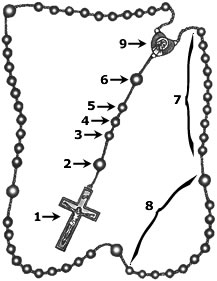
Tomorrow, we begin the Novena of Divine Mercy. The Chaplet of Divine Mercy is recited using ordinary Rosary beads of five decades. The Chaplet is preceded by two opening prayers from the Diary of Saint Maria Faustina Kowalska and followed by a closing prayer.


1. Make the Sign of the Cross

In the name of the Father, and of the Son, and of the Holy Spirit. Amen.

2. Optional Opening Prayers

St. Faustina’s Prayer for Sinners
O Jesus, eternal Truth, our Life, I call upon You and I beg Your mercy for poor sinners. O sweetest Heart of my Lord, full of pity and unfathomable mercy, I plead with You for poor sinners. O Most Sacred Heart, Fount of Mercy from which gush forth rays of inconceivable graces upon the entire human race, I beg of You light for poor sinners. O Jesus, be mindful of Your own bitter Passion and do not permit the loss of souls redeemed at so dear a price of Your most precious Blood. O Jesus, when I consider the great price of Your Blood, I rejoice at its immensity, for one drop alone would have been enough for the salvation of all sinners. Although sin is an abyss of wickedness and ingratitude, the price paid for us can never be equalled. Therefore, let every soul trust in the Passion of the Lord, and place its hope in His mercy. God will not deny His mercy to anyone. Heaven and earth may change, but God's mercy will never be exhausted. Oh, what immense joy burns in my heart when I contemplate Your incomprehensible goodness, O Jesus! I desire to bring all sinners to Your feet that they may glorify Your mercy throughout endless ages (Diary of Saint Maria Faustina Kowalska, 72).

You expired, Jesus, but the source of life gushed forth for souls, and the ocean of mercy opened up for the whole world. O Fount of Life, unfathomable Divine Mercy, envelop the whole world and empty Yourself out upon us.

(Repeat three times)
O Blood and Water, which gushed forth from the Heart of Jesus as a fount of mercy for us, I trust in You!

3. Our Father

Our Father, Who art in heaven, hallowed be Thy name; Thy kingdom come; Thy will be done on earth as it is in heaven. Give us this day our daily bread; and forgive us our trespasses as we forgive those who trespass against us; and lead us not into temptation, but deliver us from evil, Amen.

4. Hail Mary

Hail Mary, full of grace. The Lord is with thee. Blessed art thou amongst women, and blessed is the fruit of thy womb, Jesus. Holy Mary, Mother of God, pray for us sinners, now and at the hour of our death, Amen.

5. The Apostles’ Creed

I believe in God, the Father almighty, Creator of heaven and earth, and in Jesus Christ, His only Son, our Lord, who was conceived by the Holy Spirit, born of the Virgin Mary, suffered under Pontius Pilate, was crucified, died and was buried; He descended into hell; on the third day He rose again from the dead; He ascended into heaven, and is seated at the right hand of God the Father almighty; from there He will come to judge the living and the dead. I believe in the Holy Spirit, the holy catholic Church, the communion of saints, the forgiveness of sins, the resurrection of the body, and life everlasting. Amen.

6. The Eternal Father

Eternal Father, I offer you the Body and Blood, Soul and Divinity of Your Dearly Beloved Son, Our Lord, Jesus Christ, in atonement for our sins and those of the whole world.

7. On the 10 Small Beads of Each Decade

For the sake of His sorrowful Passion, have mercy on us and on the whole world.

8. Repeat for the remaining decades

Saying the "Eternal Father" (6) on the "Our Father" bead and then 10 "For the sake of His sorrowful Passion" (7) on the following "Hail Mary" beads.

9. Conclude with Holy God (Repeat three times)

Holy God, Holy Mighty One, Holy Immortal One, have mercy on us and on the whole world.

10. Optional Closing Prayers

Eternal God, in whom mercy is endless and the treasury of compassion — inexhaustible, look kindly upon us and increase Your mercy in us, that in difficult moments we might not despair nor become despondent, but with great confidence submit ourselves to Your holy will, which is Love and Mercy itself.

O Greatly Merciful God, Infinite Goodness, today all mankind calls out from the abyss of its misery to Your mercy — to Your compassion, O God; and it is with its mighty voice of misery that it cries out. Gracious God, do not reject the prayer of this earth's exiles! O Lord, Goodness beyond our understanding, Who are acquainted with our misery through and through, and know that by our own power we cannot ascend to You, we implore You: anticipate us with Your grace and keep on increasing Your mercy in us, that we may faithfully do Your holy will all through our life and at death's hour. Let the omnipotence of Your mercy shield us from the darts of our salvation’s enemies, that we may with confidence, as Your children, await Your [Son’s] final coming — that day known to You alone. And we expect to obtain everything promised us by Jesus in spite of all our wretchedness. For Jesus is our Hope: through His merciful Heart, as through an open gate, we pass through to heaven (Diary, 1570).